Saskatchewan has bad record on First Nations employment: report

Jan 21, 2013 | 9:45 AM

Bryn Levy

paNOW Staff

By 2050, conditions in Saskatchewan will be worse than they were during the Great Depression if trends in aboriginal employment aren’t turned around.

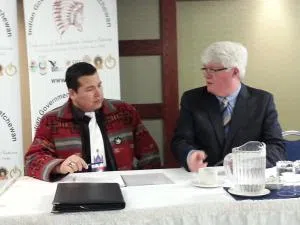
That was the message delivered by University of Saskatchewan economist Eric Howe at the release of a report he authored on behalf of the Federation of Saskatchewan Indian Nations.


The report titled Employment of First Nations People: Saskatchewan Lags Behind looked at employment data going back to 1996.

Howe said the data shows that the employment gap between Saskatchewan’s First Nations people and the general population is larger than in any province outside the Maritimes.

With population trends suggesting the province will be majority aboriginal by mid-century, Howe said the status quo can’t be allowed to continue.

“If Saskatchewan is majority aboriginal and that is combined with employment rates that are as low as they are for First Nations communities and unemployment rates that are as high as they are, we’d be talking about rates that are above what happened during the Great Depression.”

Howe traced the roots of the problem to disparities in education between aboriginals and the broader community. He noted that while more First Nations people in Saskatchewan than ever before are finishing high school and getting post-secondary degrees, those numbers don’t tell the whole story.

“There’s been a huge amount of improvement in First Nations average levels of educational attainment but they are falling behind relative to the total population,” he said.

Howe said that having the federal government match education funding for on-reserve schools to their provincial counterparts was the single biggest change that could help turn things around.

But he said the province has a part to play, noting that if Saskatchewan simply had aboriginal employment numbers as good as Manitoba and Alberta, it would add billions to the province’s GDP.

He said the role of the province is highlighted by the fact that Saskatchewan’s numbers are so bad despite a booming overall economy.

“They haven’t had a boom in Manitoba and they’re still doing better than we are,” he said.

The elimination of the province’s First Nations Employee Development Program, and the inclusion of unskilled workers in the province’s Immigrant Nominee Program are areas where Howe said provincial policy have had a negative impact on First Nations employment.

He noted that since many First Nations people entering the labour force are coming from families with generations of welfare dependency, programs and policies that hinder their access to entry-level positions are especially detrimental.

Vice-Chief Simon Bird of the FSIN said the purpose of the report was not to be used as a club against the provincial government, but rather as a way to highlight the urgency of the situation and encourage collaboration between First Nations leadership and all levels of government.

news@panow.com

On Twitter: @princealbertnow