Kinistin Saulteaux Chief has “no problem” with salaries being posted online

Aug 3, 2014 | 7:02 AM

Last week First Nations communities across Canada were to submit their financials to the federal government under the new First Nations Financial Transparency Act.

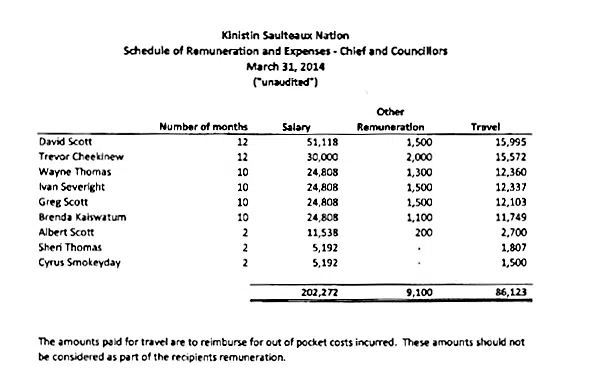
What the act does is post all Chief’s and councilors financials online for the public to see.

Saskatchewan has 70 First Nations communities and as of Friday night there were only 13 that had their financials posted online.

Those posted online right now include the Big River First Nation, the Cumberland House Cree Nation, the Mistawasis First Nation and the Kinistin Saulteaux Nation.


Kinistin Saulteaux Chief David Scott said he has no problems with their salaries being posted online.

“As an elected official it is our responsibility to be accountable to the people that we represent.”

But he said he does have some issues with the transparency act.

“It’s able to show people the own source revenue that First Nations receive. With that it provides an ability for Indian Affairs to cut back on programing … their slowly cutting back on treaty implementation by utilizing bands own source revenues to use against them, to say ‘use it for programming.’”

He said what the department doesn’t understand is a lot of the own source revenue bands receive “goes back into housing, goes back into infrastructure, goes back into investment that the department doesn’t necessarily provide for the First Nation.”

When it came to housing, Scott said what the government has done is create the Canadian Housing Corporation where a lot of First Nations have to utilize that program in order to get new housing and in turn “creating debt on the First Nation by having to go through that avenue.”

“For instance, Kinistin received $132,000 for our band based capital infrastructure costs. That’s to maintain all the housing units on the First Nation … to maintain water heaters, any unforeseen damage that’s done, etc.,” he said.

Scott said $132,000 doesn’t go along way when you have 80 plus houses to maintain throughout the year.

He said a lot of their own source revenue goes back into the First Nation by covering the costs that aren’t covered through Indian Affairs.

“In turn it creates a lot of hard times for people on the reserve because own source revenue is limited as well on the First Nation and it’s very difficult to create economic entities on the First Nations by being tied into the Indian Act and being tied into all these regulations that are put down by the federal government.”

He said there is a bit of a national attitude that First Nations are a burden and spoiled because they get tax money but that’s not true.

“Treaty was supposed to be we don’t pay taxes but that’s gone out the window. We pay the PST, the GST, we pay land taxed if we decide to buy land off reserve.”

He said their side-by-side with the average Canadian.

Scott said, “Treaty was made between two governments … coming together and trying to build a relationship to live in harmony and peace within Canada and somewhere down the line someone forgot the First Nation’s government is a legitimate government.”

For example, he said the Kinistin treaty was signed before Canada was a country and before Saskatchewan was a province so that land is Kinistin land and everything outside that is Canada and Saskatchewan.

“When treaty was signed that land was given to us to govern as we see fit,” he said.

He said he’d like to see Aboriginal Affairs “come out with an audit and to report to the people of Canada how they spent their money.”

“For the budget for what Aboriginal Affairs get, how much of that money is utilized for employment, benefits, buildings, infrastructure costs related to aboriginal affairs.

The $1.1 billion they say they give to aboriginal people a year, how much actually gets down to the aboriginal person. How much is taken for administration and employee costs, those are things that have never been reported.”

He said as a new chief coming in he’d like to see the audit down.

“If Aboriginal Affairs want to see my audit, why aren’t they showing us their audit?”

Scott was elected in May of 2012.

You can find more information on the transparency act and a list of Saskatchewan’s First Nations salaries here

news@panow.com

Twitter: @princealbertnow