(ID 2251641 © Rusty Dodson | Dreamstime.com)
WILD HORSES

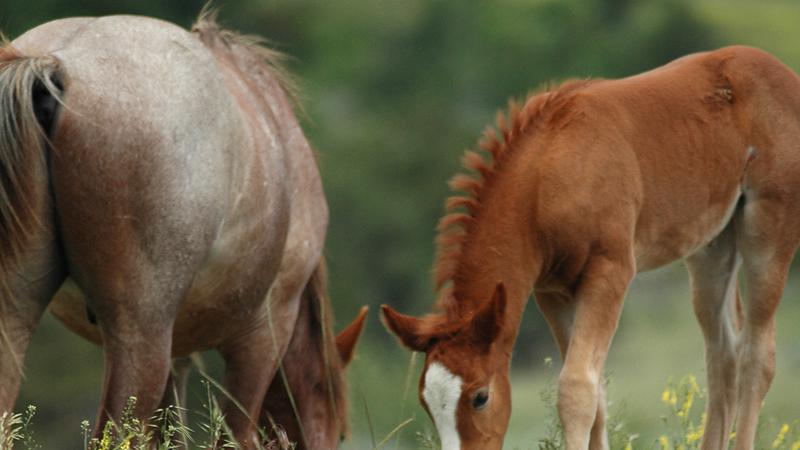
Village of Loon Lake working with neighbouring communities to solve wild domestic horse issue

Aug 20, 2020 | 3:10 PM

The Village of Loon Lake is experiencing an overwhelming rate of stray domestic animals creating a nuisance for local residents.

With the most recent council meeting on Aug 19, village councillor David Wright told meadowlakeNOW the community is working with Makwa Sahgaiehcan First Nation who are in the process of pounding posts to make a corral to impound wild horses.

“We’ve left it in their hands and hopefully we can come to a resolution soon,” Wright said. “We see about nine horses roaming in the village [on a typical day but] it’s in the hands of the band.”

Chief Ronald Mitsuing of Makwa Sahgaiehcan First Nation could not be reached for comment.

There have been no reports of injury caused by the stray horses though the animals reportedly run across highways, destroy lawns and gardens, and defecated in the community. Some residents have reported waking up to several horses on their lawn. While the horses are harmless, they present a problem.

Village residents have also expressed concern about stray dogs roaming the community on social media. Wright explained within the last year and a half, the village has hired an animal control officer who has captured more than 150 dogs who were either returned to their homes or re-homed. Wright says he is unaware of any concerned residents to date.

Village administrator Erin Simpson said since implementing the animal control officer, the problem has not gone away but has significantly improved compared to previous years.

“In my opinion, it’s a large improvement, though the village does receive calls about dogs roaming in surrounding lake [areas],” Simpson said. “The village has made clear their animal control officer is to serve the residents in the [immediate] village of Loon Lake.”

While no injuries have been reported to date by dogs, the community is concerned as two schools are in the area and dogs tend to travel in packs. The subsequent issue of stray horses becomes a challenge as horses need to be corralled and capturing wild horses can be difficult.

Loon Lake conservation officer Rylan Parenteau, with the Ministry of the Environment Conservation Officer Service said the service does not handle domestic animals, only wildlife and can only protect a specific breed of wild horses relating to the Wild Ponies of the Bronson Act. The Act protects the specific breed of ponies and does not apply to domestic breeds.

Parenteau said a possible solution could be for local R.M.’s to hire a professional to corral horses and sell them as a livestock option instead of putting them down. He said the domestic horse species roaming the area are to be solved by the community suffering from the issue, as the location of where horses roam is a factor against controlling the wandering horse population.

“There’s absolutely nothing dictating the Ministry of Environment to be responsible for these domestic species of horse,” he said. “If horses are found in the R.M., its an R.M. issue, if they’re found on reserves, it’s a reserve issue and if they’re found in the town of Loon Lake, it’s a municipal issue.”

Village staff are urging the public to take additional precautions with their pets including spaying and neutering dogs, keeping animals leashed and close to home.

According to Ministry of Agriculture spokesperson Charlotte McGraw, livestock owners are responsible for ensuring that the animals in their care are not running at large. Any animal that is running at large and not under the control of the owner, including horses, falls under The Stray Animals Act and regulations.

“Failure to keep animals contained by using a lawful fence as prescribed in the regulations can have financial repercussions for the owner of the animal in the form of fees and penalties,” she said. “Any person can restrain an animal at large. If individuals capture an animal at large, they must notify the owner if known, or their Rural Municipality (R.M.). At that point, the R.M. assumes responsibility for the care of the animal.”

There are processes under the Act where the local R.M. should be consulted and/or a local veterinarian to determine an appropriate course of action for dealing with strays that are dangerous or have no commercial value.

nicole.reis@jpbg.ca

Twitter: @nicolereis7722

View Comments