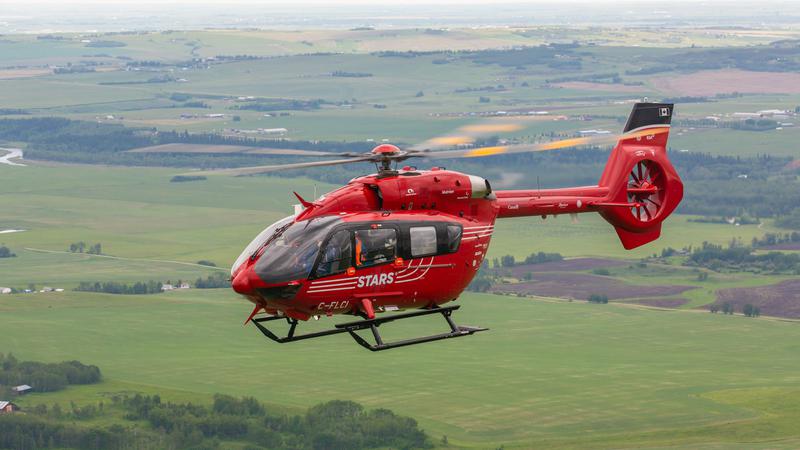
The H145 Airbus is a new addition to the STARS fleet, part of the renewal campaign in place to upgrade aging equipment. (Submitted photo/STARS)
Air Ambulance

Christopher Lake illustrates STARS significance to north

Nov 6, 2020 | 1:40 PM

A Wednesday morning accident near Christopher Lake highlighted the importance of Saskatchewan’s air ambulance service to people dealing with an emergency.

Shortly after 1 a.m., emergency responders were called out after a single vehicle rollover two kilometres east of the village of Christopher Lake. The lone injured person was taken to hospital with undetermined injuries, although not by STARS.

Cindy Seidl, who serves as a flight nurse as well as director of provincial operations with STARS, wasn’t able to provide specific details of Wednesday’s incident but did highlight some possible scenarios.

“Based on the severity, if it meets certain criteria, STARS may be auto-launched and sent to provide support,” Seidl explained. “If it was a single vehicle rollover and a patient was entrapped, that probably indicates there will be a high degree of injuries in an accident like that. If it was an accident where a patient was ejected out of the car, those type of things would trigger a STARS response.”

Although the helicopter made the trip from Saskatoon to Christopher Lake only to return empty on Wednesday, that doesn’t mean it wasn’t needed or the trip was wasted. STARS offers a number of services that aren’t available with a typical ambulance, or even in many rural hospitals.

“When you’re in STARS, we have a nurse paramedic team and we can provide the same care as you would see in an intensive care unit. We carry ventilators on board if you have issues with breathing,” Seidl noted. “We carry an ultrasound machine, so we can go to the scene of the accident and see if the patient has a punctured lung and needs a test tube prior to moving, is there fluid in the abdomen which would mean they’re bleeding and we need to get them straight to an operating room. Those are some of the things we’re able to provide that a lot of rural hospitals don’t have.”

These components, in addition to the speed factor in getting patients directly where they need to go, and the ability of a helicopter to access remote locations, round out the reasons STARS has become such an invaluable part of healthcare in the province.

Fundraising campaign

At the same time, these services don’t come cheap and the organization depends on the support of Saskatchewan residents and businesses. On Monday, STARS announced it had received a generous donation of $500,000 from MNP partners across the province which will go towards the Pegasus Project. It is an initiative created by businessman Vaughn Wyant and supported by community leaders to sell a custom 1968 Ford Shelby Mustang 727 coupe at the Barrett-Jackson Auction in January 2022. All proceeds from the project will go to STARS’ new fleet.

The need to upgrade the fleet has come about in recent years as aging equipment has made maintenance more difficult.

“Many of our helicopters are 30 years old, and it’s getting more and more difficult to find replacement parts when things go wrong,” Seidl said.

On top of that, day-to-day operations get more expensive all the time, and STARS leans on government, lottery sales, donations and fundraising, and a number of other avenues to ensure it can continue to provide world-class service to Saskatchewan.

“We need funding to put fuel in our helicopters, to train our aviation team, train our medical team, equipment and supplies so we can carry that ultrasound machine [for example] and be able to provide that innovative life-saving care,” Seidl explained.

Since 2012, STARS has flown 273 missions to Prince Albert.

trevor.redden@jpbg.ca

On Twitter: @Trevor_Redden

View Comments