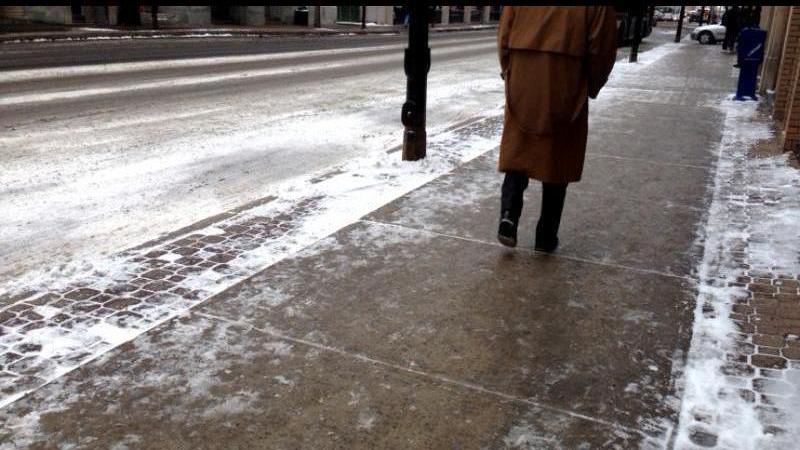
Slippery sidewalks and roadways led to some extra work for Parkland Ambulance this weekend. (File photo/paNOW Staff)
Icy Sidewalks and Roads

Ice rain leads to more slips and falls, calls to Parkland Ambulance

Jan 23, 2023 | 12:00 PM

Whether you were out walking or driving after the ice rain storm that hit Prince Albert, you had to do so more carefully than normal.

For some people who moved too quickly or missed a step, a call to Parkland Ambulance became part of their Sunday.

“We did experience a few ice-related incidents related to slip and falls,” Lyle Karasiuk, Director of Public Affairs with Parkland Ambulance said. “Many of them were people out doing errands, visiting friends and family, doing sports activities with their children, those sorts of things. So we had a few slips and falls, more than we might usually have had on a Sunday evening.”

Incidents involving the ice weren’t limited to pedestrians either. Anyone out on the highways would have seen slow travel and even some drivers who ended up in the ditch.

“It took me almost two hours to get home from Saskatoon,” Karasiuk said. “I hit the storm just right about 10:15 a.m. in the Osler, Warman area, and then continuing heading north it was a pretty icy adventure.”

Fortunately, according to Karasiuk, Parkland Ambulance did not get called out for any car crashes. That’s not to say everyone drove as safely as possible, however. On his way back from Saskatoon, Karasiuk saw plenty of vehicles in the ditch waiting for tow trucks.

“There were some people who I would say were not driving to road conditions,” Karasiuk said. “I was following a plow at a safe distance and there were people passing both me and the plow. That’s a little bit dangerous to do. There’s a reason why if a plow is going that slowly.”

As for pedestrians, going slowly in a penguin-shuffle style of the walk is recommended when dealing with icy sidewalks or crossings. If you should still slip and fall, Karasiuk said the important thing is to take an extra moment or two to check on yourself.

“The quickest thing is, we want to get up,” Karasiuk said. “But please, for that first 30 seconds or even a minute, just stop and make sure everything is working OK. Wrists, elbows, shrug your shoulders, maybe move your ankles around or flex your knees.”

Karasiuk added in adverse weather, they reduce the number of non-urgent transfers because it’s not safe to make them. He also said patients can expect ambulances to take a little longer to arrive when icy rain starts if they do have to call 911.

rob.mahon@pattisonmedia.com

On Twitter: @RobMahonPxP

View Comments