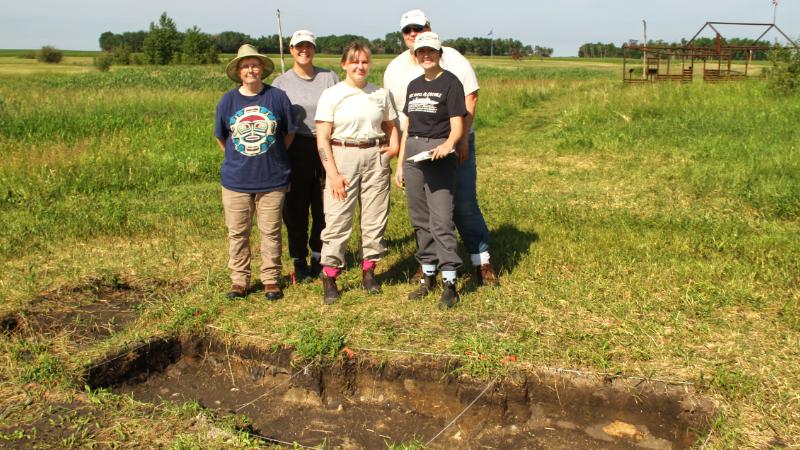
(From left to right) Peggy McKeand, Kasia Neil, Dylann Larson, Karen Steuber, and Bree Cock offered two opportunities for regular people to come to look for lost treasure at the Original Humboldt site west of the city. (Submitted photo/Becky Zimmer)
1878 to 2023

Field schools search for the lost treasures of Original Humboldt

Jun 25, 2023 | 9:30 AM

Saskatchewan history is alive at the Original Humboldt site just west of the city.

Western Heritage and the Saskatchewan Archaeological Society were out once again playing in the dirt of the telegraph station site digging for treasures buried for 145 years.

Budding archeologists were invited for field sessions on June 17 and 18 and June 24 and 25, as well as a few local school groups.

Using magnetometer and a ground penetrating radar, the archeological team has been able to see below the grassy surface before digging for things like glassware, buttons, beads, and anything else that would survive the ravages of time and the appetites of microorganisms.

It is a slow, precise, and meticulous process as the team works in 1 square metre grids, both horizontally and vertically, going down layer by layer, said Karin Steuber, public outreach coordinator with the Saskatchewan Archaeological Society.

“Once you dig up an archaeological site, it’s destroyed. So you need to take as many measurements and pictures as you possibly can in order to recreate it later when we’re doing our analysis. So as we come across artifacts, we map them in.”

Occupation zones are much different than sterile ground that has never been impacted by the presence of humans, she said, so even the soil itself tells of disturbances like fires, buildings and pathways.

Previous years of digging brought up a straight line of ground that told of the existence of a potential building. Straight lines are a telltale sign of human involvement of the area, but whether that was the exact location of the telegraph station or another structure, Steuber said they are still waiting to find out.

“Whether this is an outbuilding of it or the actual telegraph station…we need to explore the foundations of the structure a bit more, and process a bit more artifacts before we can conclusively say what it is.”

This is where they focused their efforts to see if they could find out more about the telegraph site.

The 80-acre site has been excavated in yearly sessions since 2009 with a short break due to the COVID pandemic. There is still so much more to discover of the telegraph station as well as the military camp that was there during the 1885 resistance.

“To be able to excavate and be part of discovering and doing research from that time period is just really a fantastic opportunity,” said Jennifer Fitzpatrick, director of Cultural Services for the City of Humboldt.

Every discovery is special bits of history that have seen the light of day for nearly a century and a half, said Fitzpatrick, and this is something people rarely get to take part in.

“Every piece is really interesting and helps us put the history of the site together.”

This is the fourth year of Saskatchewan Archeological Society coming to the site, so it is still early days for artifact discovery and analysis, said Stueber.

becky.zimmer@pattisonmedia.com

On Twitter: @bex_zim

View Comments