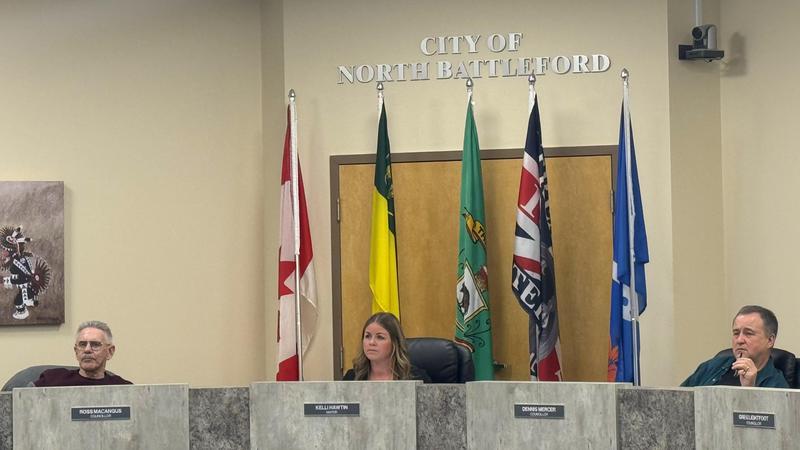
The regular city council meeting takes place in the Don Ross Centre Chamber on March 10, 2025. (Kenneth Cheung/battlefordsNOW Staff)
TRADE WAR

North Battleford backs provincial push to prioritize Canadian goods in response to U.S. tariffs

Mar 11, 2025 | 11:31 AM

The City of North Battleford has pledged to prioritize Canadian-made goods in response to U.S. tariffs, aligning with calls from all levels of government to support the national economy.

Council discussed the issue at Monday’s meeting after receiving a letter from Saskatchewan’s Minister of Government Relations urging municipalities to source goods and services from within Canada whenever possible.

Mayor Kelli Hawtin said council has directed administration to explore ways to reduce reliance on U.S. products.

“It’s a difficult task for us because a lot of our products come from all over the world, but a lot of things come from the United States. So the administration is going to have to go and look at our purchases and provide council some insight of changes we can make, or maybe some purchases we can delay, but that’ll be up to the city manager to bring that back.”


City Manager Randy Patrick said that while North Battleford is bound by trade agreements that require it to treat American and Canadian products equally, the city will make every effort to prioritize Canadian suppliers.

“It doesn’t supersede that. It (the minister’s letter) just says, ‘try your best not to use U.S. products for a loss,’” Patrick said.

He added the city will adjust its procurement process to favour Canadian-made goods whenever possible.

“I think we would just put in points for scoring whatever is in an RFP, for example, you figure how to do this, but you put on some points for Canadian content,” he said. “If you buy a truck, and it’s made in Mexico or Canada, it probably gets a higher probability than the one made in the U.S.”

As part of the new approach, the city has started requiring suppliers to disclose where their products are manufactured and assembled.

“The one thing we started doing is we are now, for like equipment purchases, we are asking vendors to provide us with where was [it] manufactured? Where was it assembled?” said James Johansen, director of engineering, planning, asset management and infrastructure.

“We want to know … what’s the Canadian content, or what’s your U.S. content of this vehicle, with this piece of equipment.”

Despite the shift, Patrick acknowledged that some essential goods—such as chemicals and specialized equipment—may still need to be sourced from the U.S.

“If we got to get it from the United States, we’re going to have to,” he said.

“It’s a very big list, and I have a preliminary kind of how we deal with it from the directors, but I’m hoping that by the time we have it all figured out, it [the tariff] is gone, honestly.”

Coun. Bill Ironstand said supporting Canadian businesses should be a priority regardless of trade disputes.

“We should all the time, not just because the province has asked us, you buy and welcome provincial and national,” he said. “On some big-ticket items, we have to look for international partners, but those dollars that we spend stay in our country, our province and our community.”

Kenneth.Cheung@pattisonmedia.com

View Comments