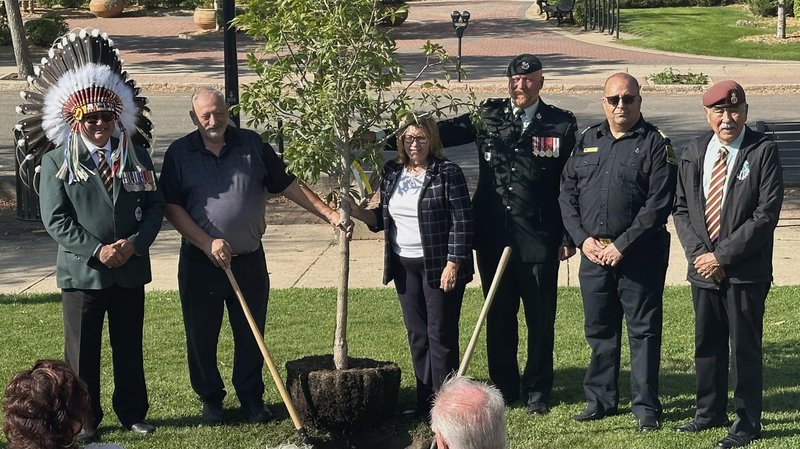
Local and provincial dignitaries stand by the tree that was planted in front of City Hall on Saturday. The tree, an Ohio Buckeye, will grow up to be 60 feet tall. (Logan Lehmann/paNOW Staff)
Looking back

CAF marks tenth anniversary of Operation Lentus 15-02 with tree planting at City Hall

Sep 20, 2025 | 11:33 PM

A symbolic tree was planted in front of Prince Albert City Hall on Saturday morning.

The tree, an Ohio Buckeye, was planted to mark the 10-year anniversary of the devastating wildfires in Northern Saskatchewan, and to be a symbol of thanks to the Canadian Armed Forces (CAF) for their efforts during the emergency.

The ceremony began with prayer and a smudging of those who were in attendance and of the tree that was going to be planted.
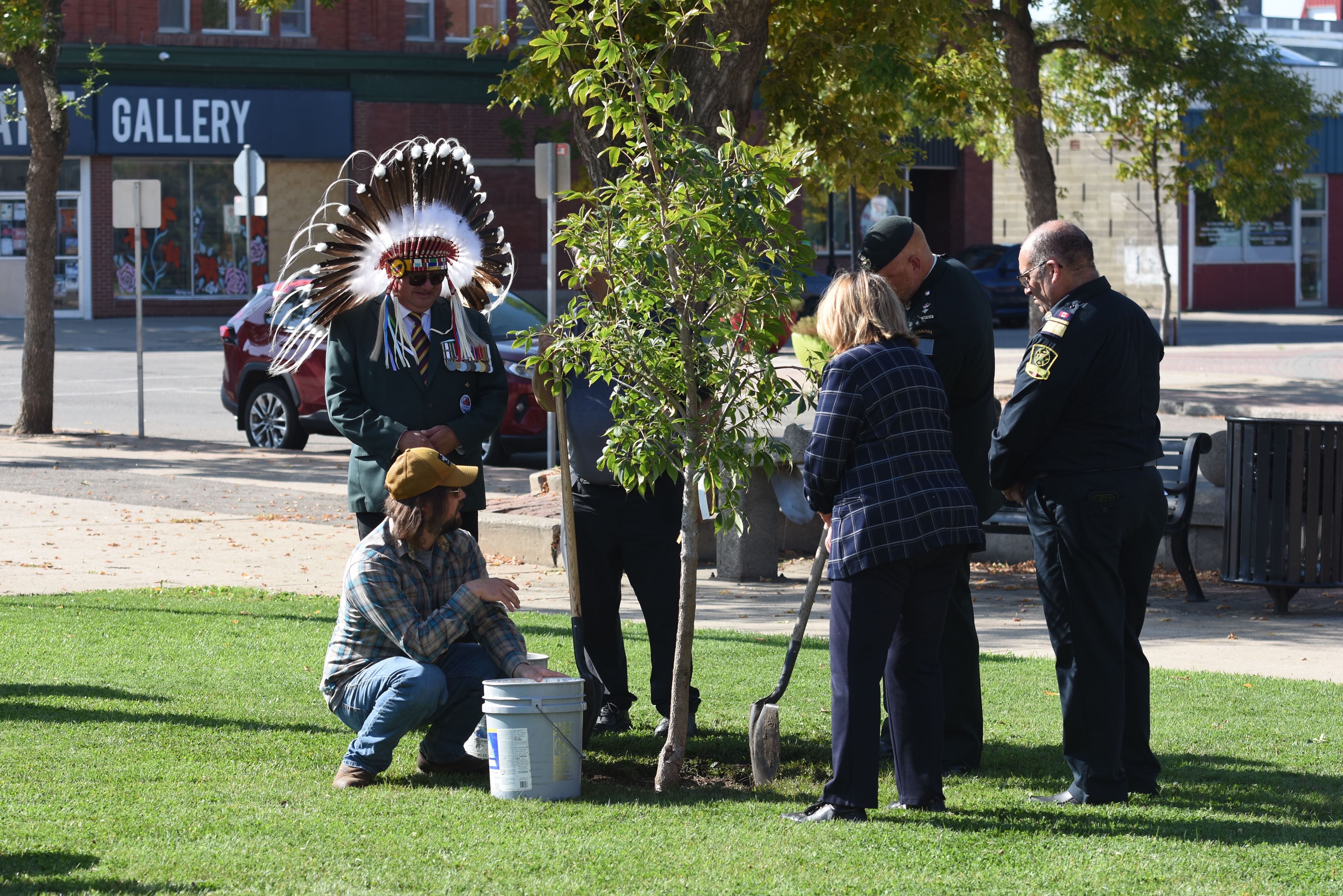
The tree is put into the ground. (Logan Lehmann/paNOW Staff)
CAF personnel were joined by local and provincial dignitaries at City Hall, including MLA Alana Ross.

“It was a time that tested our strength, our resilience, and our commitment to one another,” she said, speaking about the 2015 wildfires. “The scale of the crisis was overwhelming, and yet communities, governments, and first responders from all levels became united for a powerful response. When our government asked for assistance, the Canadian Armed Forces stepped up.”

The 2015 wildfire season was one of the worst on record in Saskatchewan. Over 700 fires torched nearly 1.8 million hectares of land and forced the evacuations of over 50 northern communities, around 13,000 people, marking the largest evacuation in the province’s history.

That sparked Operation Lentus 15-02, where approximately 850 CAF members were deployed to the North to help local firefighting teams with conducting fire line operations near towns and critical infrastructure, putting out hotspots in and around vulnerable communities, and providing logistic support. The operation was a success, and no lives were lost.

Lieutenant-Colonel Mike Graver, Commanding Officer of the North Saskatchewan Regiment, was one of the CAF members in attendance and was also one of the personnel deployed to Northern Saskatchewan in 2015; he shared some of his memories from that time.

“This operation is something that I’m very proud of, and I remember at the time, trying to rally the troops to get people to volunteer to go to this, and I said, ‘This is a no-fail task, this is the home game.’ What I meant by that was this is a domestic operation. It’s on our home turf, it’s in our backyard, and we’re there to help secure and protect Canadians.”

Graver led a group of 100 soldiers called a domestic response company, which was composed of members from Ontario, Manitoba, and Saskatchewan who were also a part of the 38 Canadian Brigade Group, Canada’s largest brigade group.

“We had two weeks in and around La Ronge,” he continued. “We did our daily tasks of wildfire fighting, information gathering, and delivering community support. To this day, I still run into people from that area, from La Ronge, and they’re still very thankful for the military assistance provided in that operation.”

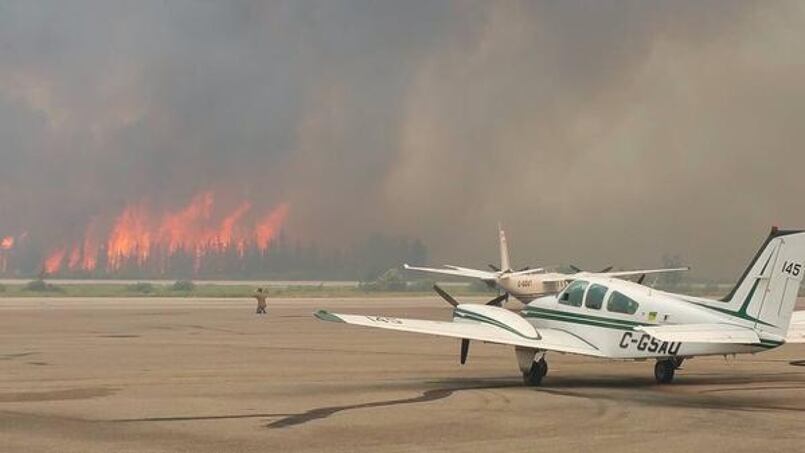
A man captures photos of the flames as it approaches the La Ronge Airport in June 2015. (Prince Albert Fire Department/file)

He added that military responses to wildfires will become more common across the country as summer fire outbreaks are becoming more of the norm. Just this past summer, around 400 soldiers were deployed to Northern Saskatchewan to combat the more than 480, and counting, wildfires. Wildfires in 2025 have scorched more than three million hectares of land, as of Sept. 3.

“We, in the Canadian Armed Forces, trained for these types of deployments, both foreign and domestic. We need to always protect our homeland, our borders, and our people above all else. This is why these types of deployments are so important to our soldiers and why I’m so proud of the support we provide to Northern Saskatchewan in these types of deployments,” said Graver.

loganc.lehmann@pattisonmedia.com

On Bluesky: @loganlehmann.bsky.social

View Comments