Missed credit payments are down, but consumers in Saskatchewan are still struggling. (ID 134389271 © Samwordley | Dreamstime.com)
Finances

Saskatchewan delinquencies dip, but experts warn debt struggles persist

Sep 24, 2025 | 1:47 PM

Saskatchewan has seen a slight drop in delinquency rates. While fewer people failed to make a debt payment on time, experts say the decline doesn’t necessarily mean the financial situation for people in the province is improving.

The credit reporting agency TransUnion Canada said 1.94 per cent of consumers in Saskatchewan have some kind of delinquency. That’s down 3 basis points from the last quarter and pales in comparison to Alberta and Ontario where delinquency rates increased by 16 and 17 basis points, respectively.
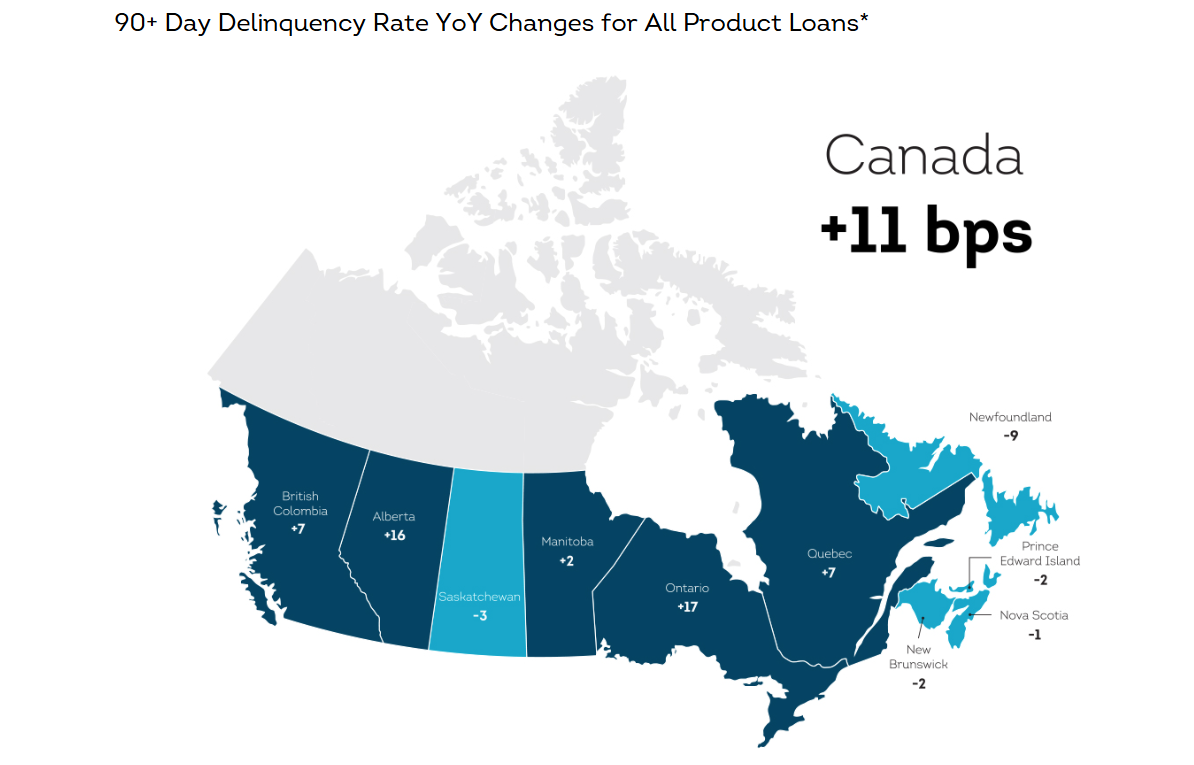
TransUnion Q2 Credit Industry Insights 2025 Report. (Screenshot/transunion.ca)

Director of Research and Consulting at TransUnion Canada, Matt Fabian said a year or two ago, Saskatchewan had one of the highest delinquency rates among provinces, so there seems to be ‘some positive progress.’


“What we’ve started to see is as interest rates are coming down, and certainly as inflation is coming down, that’s alleviated some of that pressure. We’re starting to see consumers start to kind of rightsize again and as a result, across many provinces, but certainly Saskatchewan, we see a drop in delinquency rates maybe because consumers are having the chance to kind of pause and catch their breath,” Fabian said.

He explained unemployment numbers are an early indicator of stress for credit, but Saskatchewan is ahead of the game in terms of strong economics and employment figures.

Earlier this week, Premier Scott Moe touted the province as the most affordable place to live in Canada, with an economy set to outperform the nation as a whole in 2025. The official opposition, meanwhile, highlighted the findings of a recent Angus Reid poll that found 66 per cent of people in Saskatchewan said they can’t keep up with the cost of living, the highest rate in the country according to the poll.

Jasmin Brown, licensed insolvency trustee and senior vice president at BDO Debt Solutions said compared to last year, there are slightly less people filing for bankruptcy or consumer proposals in the province, but there are still high numbers of people that need help with their debt.

“What we see is that people are struggling with even the basic cost of living. Go to a grocery store and you see, I mean everybody is seeing that the prices are much higher. So, to me, it’s a bit deceiving to read in a [credit bureau] report that the delinquencies are stabilizing. It doesn’t mean that people still aren’t delinquent, and also a lot of people aren’t aware that just making minimum payments is actually a sign of financial difficulty,” Brown said.

The average consumer in Saskatchewan has about $27,000 in non-mortgage debt (credit cards, auto loans, etc.) – that’s up 1.1 per cent from last year. Brown said younger Canadians in particular are reaching out for help because they’re overextended.

“They’re having to rely on credit to pay for things like food and shelter and basic needs. So, there’s nothing left over. And they’re using credit to fill the gap, and at some point, that kind of becomes like a house of cards that’s going to tumble.”

The Credit Counselling Society (CCS) said it too has seen a decrease in the number of people from Saskatchewan seeking debt solution help so far this year, but of the consumers that have spoken to a counsellor, 26 per cent of them are 35 years old and younger. CCS director of counselling, Mason Cox said credit bureaus may be reporting a decline in delinquencies, but that doesn’t mean consumers aren’t struggling.

“It says people are still holding on, but as we know, if they’re barely holding on and we’re hearing the other side of the coin saying I am one payment away or one missed step away from all of this crumbling – that’s the real story,” Cox said. “There may be debt payments, but people are sacrificing something to make those payments…maybe less food on the table, a little less gas in the car or kids aren’t going to summer camp. There’s only so many expenses you can cut overall to supplement some of that, and once you get into the necessities, that’s when the big worry is for a lot of individuals.”

Both Cox and Brown said just speaking to an insolvency trustee can offer some relief when it comes to debt stress.

“If you were physically sick, you would consult your doctor. If you are financially sick and overwhelmed, there are professionals out there that can help you with results and find solutions,” Brown said.

teena.monteleone@pattisonmedia.com

View Comments