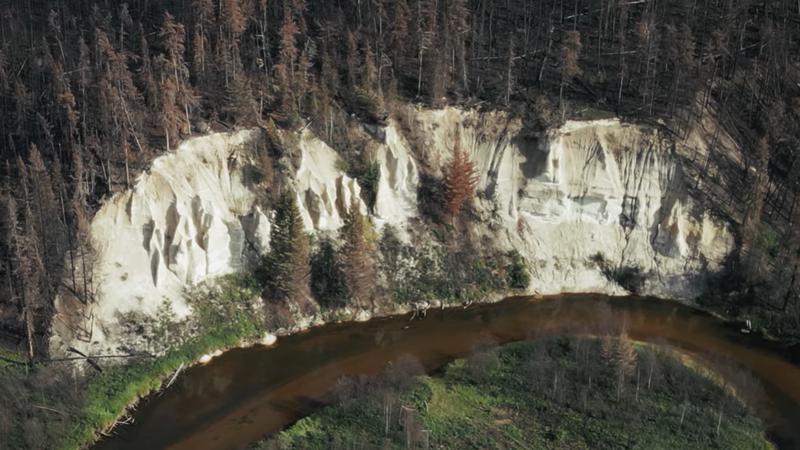
The Nipekamew Sand Cliffs are located about 60 kilometers southeast of La Ronge. (Crosscut Films)
protected site

Wildfire destruction could speed up erosion of ancient land formation

Oct 28, 2025 | 1:27 PM

A video uploaded to YouTube last week is raising awareness of the wildfire impact on the Nipekamew Sand Cliffs south of La Ronge.

The Nipekamew Sand Cliffs are a 125-million-year-old land formation created by an ancient river during the Cretaceous period. The sandstone cliffs are a protected area and erosion has made them extremely fragile.

Filmmaker Scott Woroniuk was in the area in September and he decided to make a short four-and-a-half-minute video for his YouTube channel Crosscut Films.

“It’s kind of a heartfelt comparison to what before and after looks like at a spot that has been in the hearts of people over the years,” he explained.

“From before the wildfire and its green canopy and its beautiful little winding trail and the beauty of the sand cliffs, to the devastation of that same canopy and how heartbreaking that loss is knowing it will never look that way again while I’m walking the Earth.”

Once surrounded by mature jack pine and spruce trees, the area was burnt to a crisp after a large wildfire swept through in June. That destruction is worrying to Woroniuk as the land formation is so delicate.

“Because we lose that moss and a little bit of topcoat and the trees will be dying off from being burnt, that could lead to that top layer of soil becoming loose and it might lead to some erosion down the road,” he said.

Crosscut Films/YouTube

That concern is shared by University of Regina geology professor Meagan Gilbert, who has done extensive research on the Nipekamew Sand Cliffs.

“Erosion is a very natural process and forest fires are a very natural process of boreal forest ecology,” she remarked.

“In some senses, that area burning has probably happened before and it will probably happen again. The cliff are about 125 million years old, so they have endured 125 million years of erosive processes. It probably will change them in some sense, but the sand those cliffs are made out of extend for over 100 kilometers.”

Even without the fire that went through in June, Gilbert noted the sand cliffs are in a constant process of erosion due to the river that flows beside them. She added while the effects of the fire could speed up erosion somewhat, the result will be the uncovering of more sand.

Gilbert mentioned the sand cliffs are a rather special geological feature because it is one of only a few spots in Saskatchewan where that particular group of rocks is exposed on the surface.

“It’s a snapshot in time of a very ancient ecosystem and environment,” she said.

“The Earth is four billion years old, so there has been a lot of things that have happened to it, but it’s very uncommon to have those snapshots first of all preserved, and second of all exposed on the surface. Anytime we have those deposits exposed on the surface, it’s very scientifically significant and very important.”

Woroniuk has been creating videos for Crosscut Films since 2011, and readers may be interested in another film set to be released on Friday. It showcases the now formally documented crash site of a 1948 U.S. Navy Beechcraft Expeditor flight, which went missing in Northern Saskatchewan in 1948.

derek.cornet@pattisonmedia.com

View Comments