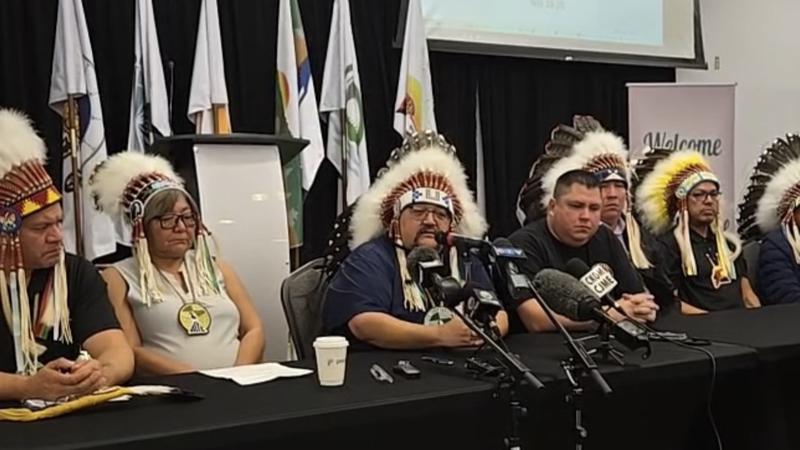
Meadow Lake Tribal Council (MLTC) Vice-Chief Richard Derocher, centre, addresses reporters during a press conference on policing and public safety concerns at Prairieland Park’s Terrace Room in Saskatoon on Nov. 19, 2025. (MLTC/Facebook)
PUBLIC SAFETY

‘We need presence’: MLTC presses province as police shortages fuel First Nations public-safety crisis

Nov 19, 2025 | 5:52 PM

Leaders with the Meadow Lake Tribal Council (MLTC) feel their communities are facing a public-safety crisis fuelled by chronic RCMP shortages, long response times and a policing model that they believe is no longer working.

The council said several of its nine northern First Nations are lacking adequate numbers of police officers and often responding members are dispatched from neighbouring communities.

Tribal Chief Jeremy Norman said the result is dangerously slow response times.

Many communities, he said, are supposed to have as many as five officers but some of them are “lucky to have one.” In emergencies, callers often wait an hour for RCMP to arrive — a delay he described as “a huge safety concern.”

“By the time the crime’s committed, the people are gone. So, we need [RCMP] presence in the community. We don’t need a one-hour wait time.”

A fatal dog mauling in Ministikwan Lake Cree Nation in July underscored the consequences.

“By the time they got there, the dog was still there, but the young lady, she passed away,” Norman said. He added officers were “50 some minutes” behind.

Norman said the crisis persists despite tripartite agreements intended to guarantee policing levels, visibility and prevention efforts. Those commitments, he said, “are supposed to spell that out… and they’re not happening.”

He recognizes the RCMP is not at fault alone.

“We understand that there’s a shortage of members,” he said. “We know that they’re struggling to get them in.”

At a press conference in Saskatoon Wednesday, MLTC Vice-Chief Richard Derocher said the council sees the Saskatchewan Marshals Service (SMS) as a possible way to improve safety.

“Premier Moe has a police force, the Marshals… that’s an opportunity,” he said. “We are looking for a fix today, we are not looking for a fix in 10 years.”

Derocher said MLTC has already notified Meadow Lake MLA Jeremy Harrison and will continue discussions with the province.

Norman said the SMS is appealing because officers are fully trained, the organization is recognized by the courts and actively building relationships with First Nations. The appointment of a superintendent of First Nation, Métis policing and special initiatives, he said, signals a commitment to work directly with communities.

“There’s definitely benefits in the Marshals program,” he said.

He added MLTC would “definitely” consider an agreement similar to the memorandum of understanding(MOU) Red Pheasant Cree Nation signed with the Marshals in October, which outlines direct communication and coordinated policing support.

Norman also commented on Ottawa’s plan to hire 1,000 additional RCMP officers. While it’s still unclear how those positions will be deployed, he said the move “definitely could help” if officers are actually sent north — “if they’re going to come and be put in our communities.”

MLTC is also completing a feasibility study on creating a First Nations–controlled police service. Norman said it remains a long-term project and will not address the immediate gaps his communities are facing.

He also questioned why federal funding continues to flow into the current RCMP model despite longstanding concerns.

“They throw it at something that ain’t working, we’re not happy with it and and yet, that system is just not working,” he said.

Through all discussions, Norman said MLTC’s goal is straightforward.

“All we want is a safe community for our kids, a safe community for our people,” he said,

MLTC represents Birch Narrows, Buffalo River Dene Nation, Canoe Lake Cree First Nation, Clearwater River Dene Nation, English River First Nation, Flying Dust First Nation, Makwa Sahgaiehcan First Nation, Ministikwan Lake Cree Nation and Waterhen Lake First Nation.

-With files from CKOM

Kenneth.Cheung@pattisonmedia.con

View Comments