(Image Credit: ID 148267728 © Robert Little | Dreamstime.com)
moulting season

Why are Canada geese walking everywhere? They just can’t fly… for now

Jul 20, 2026 | 5:15 PM

If your evening walk has recently involved weaving around Canada geese at the park or waiting for a flock to cross the path, you’re not imagining things.

Across the country, not just Saskatchewan, the birds seem to be spending far more time on foot than in the air.

They’re not forgetting how to fly. For a few weeks every summer, they simply can’t.

Canada geese are in the middle of their annual moulting season, replacing the flight feathers that will carry them south in the fall.

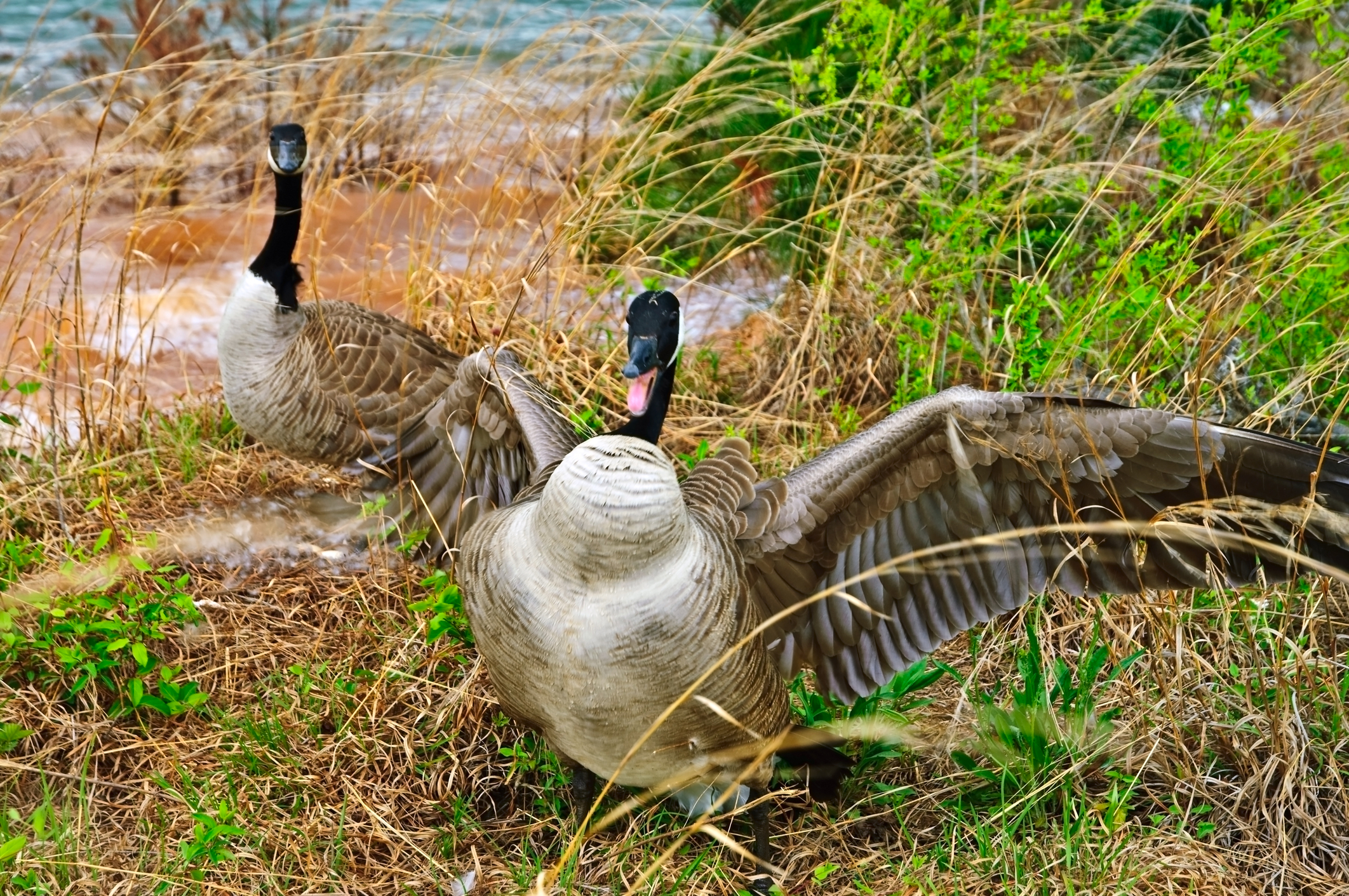
“So that moulting period for geese is kind of right about now until into August,” said Ryan Fisher, curator of vertebrate zoology at the Royal Saskatchewan Museum.

“And that moulting season for the geese is usually about a month, maybe a little bit longer.”

Canada geese are unusual because they lose all of their flight feathers at once.

“So geese and ducks are the only types of birds that do that; they’re not able to fly at certain times of year,” Fisher said. “Other types of birds do moult, but they sort of moult one feather at a time so that they can still fly.”

“You’ve got adults who are replacing some of their feathers, and then you’ve got these young ones who are growing their new feathers, and none of them are able to fly right now.”

Losing the option of flying away also changes how geese react to people.

“If you think their usual strategy when they’re able to fly, they would probably just run and fly away from you, but they’re not able to do that right now,” Fisher said.

“So they are a little bit more aggressive.”

“Mom and dad are also just a little bit more aggressive as well, because they want to make sure that those goslings survive and leave to migrate in the fall.”


(Image Credit: ID 13912141 © Susan Leggett | Dreamstime.com)

For anyone sharing a trail with them, Fisher said the solution is simple.

“My advice is always to give them a wide, wide berth and, you know, just sort of go around a big, big flock like that if you can,” he said.

If walking around them isn’t possible, “try not to get in between mom and dad and the goslings.”

The larger flocks showing up in parks and near lakes aren’t a coincidence either.

“If you’re one Canada goose and you can’t fly, it’s probably better to be in a big flock to have other eyes looking out for predators and things like that,” Fisher said.

“And so they do tend to aggregate together, kind of form into larger groups when they’re moulting.”

As Fisher puts it: “Safety in numbers.”

Even wildlife experts know better than to push their luck.

“I’ve been lucky and I haven’t been attacked, but they will definitely hiss, and they’ll kind of spread their wings out to make themselves look big,” Fisher said.

“In those cases, it’s sort of a matter of trying to get out of there as quick as you can so that you don’t stress the bird out.”

“A wide berth when you’re walking is always the best idea in my experience.”

Canada geese are protected under federal migratory bird legislation, meaning people cannot intentionally harass them or disturb their nests or eggs, though simply walking through a park isn’t a problem.

Those summertime goose traffic jams won’t last forever. Once their new feathers have grown in, the birds begin fueling up for migration.

“They’ll start to fuel up, so they’ll be eating a lot, eating a lot of grass, a lot of seeds and things like that,” Fisher said.

Later in September, many Canada geese begin heading south, although some remain in Saskatchewan until colder weather arrives.

Fisher hopes people remember there’s more to Canada’s iconic bird than its noisy reputation.

“I know people aren’t necessarily always happy all the time with all the geese in cities, but they are actually kind of a neat conservation story,” he said.

“So Canada geese were actually once endangered.”

According to Natural Resources Canada, there are now an estimated seven million Canada geese across North America. Most regional surveys show populations are stable or increasing, and geese have returned to many parts of southern Canada where they were once considered completely wiped out.

“There were very few of them in Prairie Canada, and through lots of efforts, they’ve rebounded spectacularly and are doing quite well now.”

“So it’s kind of one of those neat stories where conservation was actually really, really successful for Canada geese.”

Kenneth.Cheung@pattisonmedia.com

View Comments