Rendering of the completed DilSAP facility. (Image Credit: Cenovus Energy)
DILUENT RECOVERY AND INJECTION FACILITY

Cenovus Energy outlines proposed DilSAP expansion at Spruce Lake

Aug 21, 2026 | 12:46 PM

Community members in the Spruce Lake area gathered Thursday for a Cenovus Energy open house to learn more about the company’s proposed diluent solvent-aided process (DilSAP) project.

The DilSAP project is an expansion of Cenovus Energy’s existing Spruce Lake facilities. It would use a liquid called diluent, along with steam, to help produce oil while reducing the amount of steam needed.

The company describes the diluent used in the project as condensate, a liquid similar to diesel that occurs naturally in the reservoir.

The project, intended to improve operations at the site, would include a standalone Diluent Recovery and Injection Facility, along with tanks and other equipment similar to those at the company’s two existing facilities.

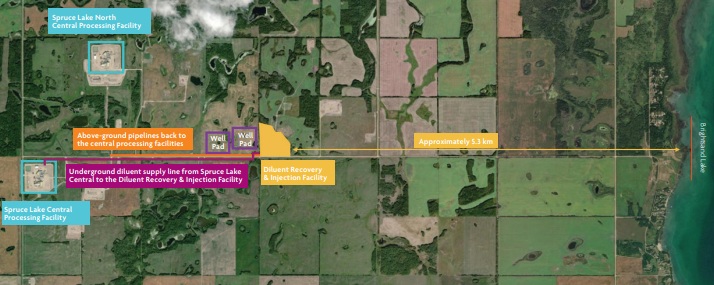
The project would also include a 3.5-kilometre underground pipeline connecting the new facility to Spruce Lake Central to supply diluent. Above-ground pipelines would carry steam, emulsion and fuel gas.

Spruce Lake DilSAP project overview map.
Spruce Lake DilSAP project overview map. (Image Credit: Cenovus Energy)

Several residents who spoke with battlefordsNOW said they attended to learn more about the project and ask questions. Those residents said they left the open house without immediate concerns. 

What is new? 

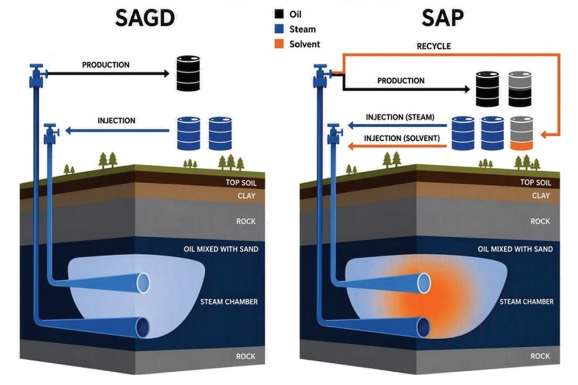
The main difference between traditional steam-assisted gravity drainage (SAGD) and the solvent-aided process (SAP) is the addition of a light hydrocarbon solvent.

SAGD vs SAP diagrams.
SAGD vs SAP diagrams. (Image Credit: Cenovus Energy)

The process is designed to use water more efficiently by reducing the amount of steam needed to produce oil. The extra steam can then be directed to new wells, allowing production to increase without increasing water use.

Once complete, Cenovus Energy expects the project to reduce greenhouse gas emissions per barrel by 30 per cent while increasing production by about 10,000 barrels per day.

Expected impacts 

Cenovus Energy expects the project to improve oil recovery from existing well pads while lowering operating costs by reducing the amount of steam needed.

The project is also expected to generate additional municipal tax revenue through project development and operations.

Environmental monitoring and water protection 

Cenovus Energy has ongoing environmental monitoring at its Spruce Lake operations.

Air monitors around the facilities continuously check for hydrogen sulphide, sulphur dioxide and nitrogen dioxide. Staff review the results, which are provided to the Saskatchewan Ministry of Environment when requested.

Groundwater is also monitored at the Spruce Lake Central and Spruce Lake North facilities.

Water running off facilities and well sites is tested before it is released. The same testing and release procedures will be used at the DilSAP well pads once they are operating.

Travis Shackleton, Cenovus Energy’s vice-president of Canadian thermal and Canadian heavy oil geosciences, said the project also includes measures to protect groundwater and surface water during drilling.

“The protection of our people, our local communities, and the environment is Cenovus’ top priority. Safety is built into everything we’ve done to this project plan,” he said.

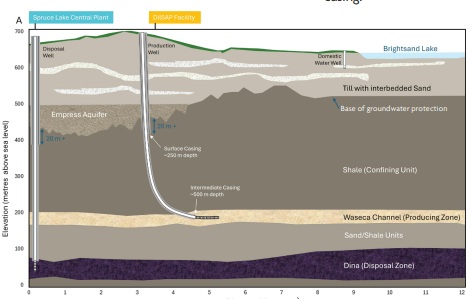
Resource wells use multiple layers of protection. Steel surface casing is installed below freshwater aquifers and cemented in place to prevent water, gas or other fluids from moving into groundwater.

Well design to protect water resources
Well design to protect water resources (Image Credit: Cenovus Energy)

Cenovus Energy said its standard practice is to install surface casing at least 20 metres below the base of groundwater protection, exceeding Saskatchewan requirements.

In the Spruce Lake project area, the base of groundwater protection ranges from about 125 to 290 metres deep. Brightsand Lake is about 12 metres deep, based on public data.

As drilling continues deeper, additional steel casing is installed and cemented in place. This provides another layer of protection between deeper rock formations and the freshwater aquifers above.

“Cenovus does gather environmental reporting and sampling on a general cadence. The data is collected and provided to the Ministry of Environment annually, and that data is available through them (for residents),” Shackleton said.

Community impacts 

Shackleton said the biggest impact on the community is expected during the construction phase.

“There will be a construction window in addition to the existing facilities. The construction window will be approximately a year to get those facilities built.”

“For the construction window, we’re looking to employ approximately 200 individuals during that construction period. Then when it’s general operations; we’re looking for approximately four new operator positions too,” he said.

Construction is expected to begin later this year and continue through the first quarter of 2027, with start-up anticipated toward the end of the year.

Alyssa.rudolph@pattisonmedia.com

View Comments