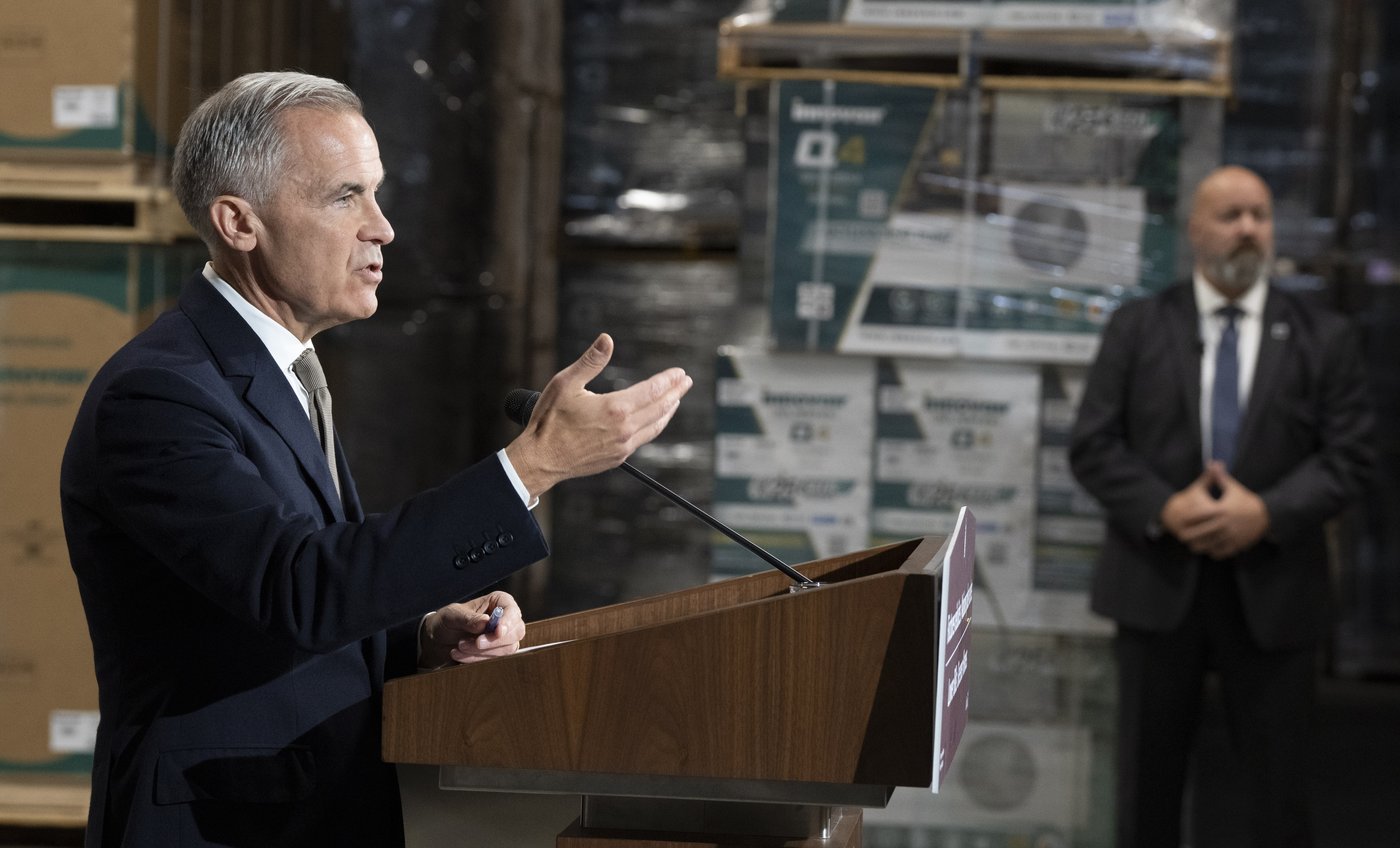
Prime Minister Mark Carney announces a new federal heat pump rebate program in Sherbrooke, Que., on Thursday, Oct. 8, 2026. THE CANADIAN PRESS/Christinne Muschchi

Special House committee votes to push forward major projects bill

Oct 9, 2026 | 1:15 PM

OTTAWA — A special House of Commons committee created to study the Liberals’ new economic bill agreed Friday to limit the period it can receive submissions and hear from witnesses.

Members of Parliament passed a motion to begin clause-by-clause consideration of Bill C-39 in mid-November. The House is set to sit until mid-December.

The committee agreed to invite Transport Minister Steven MacKinnon, Environment Minister Julie Dabrusin, Jobs Minister Patty Hajdu and Canada-U.S. Trade Minister Dominic LeBlanc to appear before the committee.

It also agreed to issue a press release asking interested stakeholders to submit briefs to the committee by Oct. 26.


At the start of Friday’s committee meeting, chair and Liberal MP James Maloney named three ministers who he said could appear before the committee Oct. 19. He did not name Dabrusin.

In response to backlash from MPs, Maloney said Dabrusin could be included in parties’ witness lists, which must be submitted by next week. The committee later agreed to invite Dabrusin, but there was no confirmation of her attendance or date set.

NDP MP Don Davies has accused the government of trying to ram the bill through at high speed.

Davies, who attended Friday’s meeting despite not being on the committee, told reporters afterwards that he has concerns about the speed of the process and worries the committee won’t hear from Indigenous, environmental and labour groups.

“They’re shutting out the voices of Canadians,” said Davies.

The 243-page bill, which passed its first vote in the House of Commons on Thursday, proposes to extend the government’s one-project, one-review, within-one-year approach to major infrastructure projects to apply to other projects across the country.

The legislation is a core part of the Liberals’ plans to pivot the economy away from reliance on the United States and present Canada as a reliable trading partner to overseas markets.

Conservative Leader Pierre Poilievre said Thursday his party would support sending the legislation to a committee study in order to propose amendments to what he called a “weak, watered-down, long-delayed” bill.

Poilievre told reporters he wants the government to speed up the decision timeline on projects to between six months and a year, and to add measures to protect workers’ rights.

He also said Conservatives would seek to eliminate the industrial carbon price and create shovel-ready zones with pre-permitting for developments.

A collective of First Nations groups has condemned the legislation. In a joint statement issued Thursday, the First Nations said the bill would weaken environmental oversight and strip away their ability to influence decisions affecting their territories.

The Chiefs of Ontario, Assembly of First Nations Quebec-Labrador, Nishnawbe Aski Nation and the British Columbia Assembly of First Nations said their “free, prior, and informed consent cannot be squeezed into a predetermined federal project timeline.”

“First Nations are not barriers to Canada’s economic future. First Nations are rights holders, governments, title holders, Treaty partners, and essential to building sustainable economies,” the statement said.

“Attempts to bypass First Nations rights will create greater uncertainty, conflict and litigation, the opposite of what Canada says it’s seeking. Any path towards economic growth must respect First Nations rights, jurisdiction, and responsibilities to lands and waters.”

This report by The Canadian Press was first published Oct. 9, 2026.

— With files from David Baxter and Alessia Passafiume

Catherine Morrison, The Canadian Press