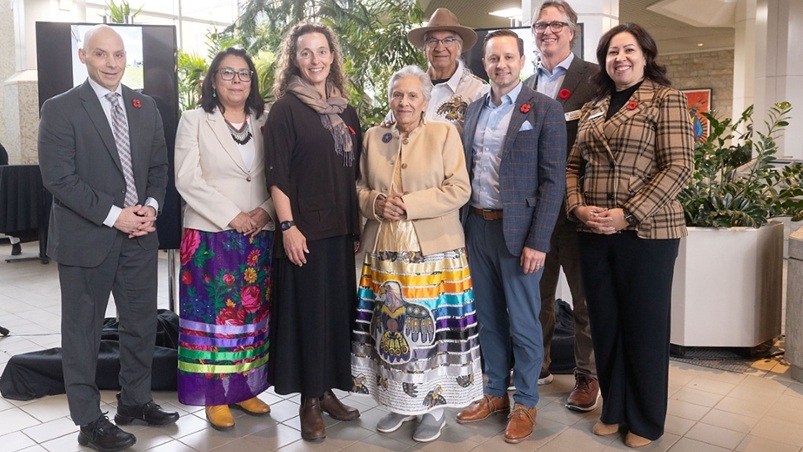
From left: President Vince Bruni-Bossio (USask); Candice Pete-Cardoso, Director, kihci-okāwīmāw askiy Knowledge Centre (USask); Dean Angela Bedard-Haughn (College of Agriculture and Bioresources); Elder Julie Pitzel; Knowledge Keeper Joseph Naytowhow; Tim McMillan, Vice President, Strategy (Nutrien); Steve Shirtliffe, Director, Nutrien Digital Agriculture Centre (USask); Julie Ann Wriston, Director, Indigenous Relations (Nutrien). (Image Credit: supplied photo/Usask)

A new chapter for digital agriculture and Indigenous knowledge at USask

Nov 3, 2026 | 3:33 PM

The University of Saskatchewan (USask) officially opened the Nutrien Digital Agriculture Centre and the kihci-okâwîmâw askiy (Great Mother Earth) Knowledge Centre.  

The two centres, located just steps apart, mark the beginning of a new chapter for the College of Agriculture and Bioresources and the communities they serve.  

The $15-million gift from Nutrien to the university was made last year during the university’s Be What the World Needs campaign.

The Nutrien Digital Agriculture Centre (NDAC) will support digital agriculture research and collaboration with a goal of accelerating farming into the digital age. 

Designed as a collaborative hub with workstations, meeting areas, and spaces for industry and community partners to meet, the centre will be home to researchers, staff, and students supporting three research platforms. The Geospatial Agroecosystem Inference Generator (GAIG) is designed for mapping and analyzing agricultural ecosystems; the UAV Crop Phenomics Platform will accelerate plant breeding, crop research, and agricultural management; and the Smart Farm platform will help farmers improve practices under real-world conditions.  

NDAC Director Dr. Steve Shirtliffe said they are in the right place at the right time to make a meaningful difference in agriculture.  

“We know there is tremendous interest in digital agriculture, and this space will be a magnet for bringing together researchers, students, producers, industry partners, and communities while supercharging our research in ways that weren’t possible before,” Shirtliffe said 

The kihci-okawimaw askiy Knowledge Centre supports the development of land-related teaching, research, and engagement opportunities important to Indigenous communities.  

The renovated space features Indigenous-designed elements that reflect treaty relationships and connections to the land, including a river woven through the flooring, a dedicated gathering space for Elders and Knowledge Keepers, and areas designed to support learning, relationship-building, and community engagement.  

The centre will provide a physical space for askiy workshops, which offer a unique professional development opportunity focused on Indigenous perspectives of land, history, worldviews, and contemporary challenges.  

The kihci-okawimaw askiy Knowledge Centre Director Candice Pete-Cardoso said the space is a representation of the future for Indigenous peoples.  

“Our work is for the next seven generations,” Pete-Cardoso said. “It’s about decolonizing and reconciliation in action.”  

Students enrolled in the Kanawayihetaytan Askiy Certificate Program will attend classes at the centre and have a home base on the USask campus.

Senior strategic officer Jordie Gagnon will also host ongoing Indigenization workshops for College of Agriculture and Bioresources staff and faculty in the centre. 

–

alice.mcfarlane@pattisonmedia.com