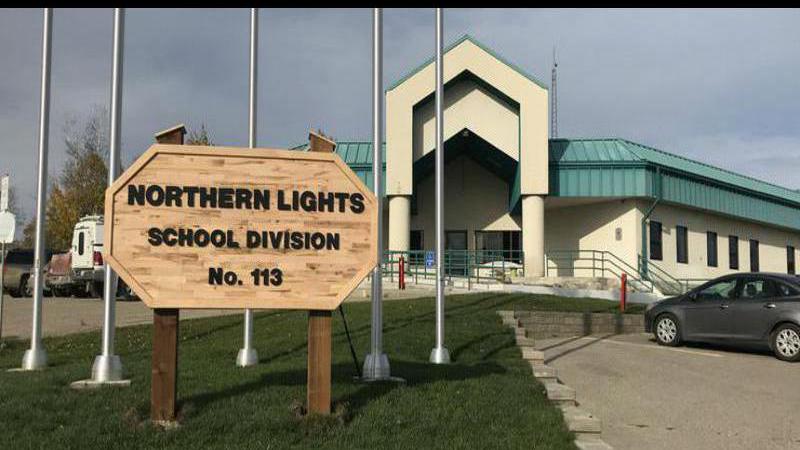
Only 40 per cent of Northern Lights School Division students graduated on time on 2021. (Derek Cornet/larongeNOW Staff)
annual report

NLSD attendance rates drops 50 per cent is some communities

May 3, 2022 | 3:26 PM

Northern Lights School Division (NLSD) director of education Jason Young is concerned about the impact low attendance rates will have on the success of students in the years to come.

The school division released its 2020-2021 annual report recently, which provided a breakdown on everything from enrollment and wages, to credit attainment and graduation rates. In an interview with larongeNOW, Young explained the time period highlighted in the report is from a period when COVID restrictions were still in place throughout Saskatchewan.

He noted there was a 20 to 30 per cent drop in attendance across Kindergarten to Grade 12. In some communities, that attendance drop was as high as 50 per cent.

“It certainly is alarming. I think missing that much school is obviously going to have an impact on your ability to gain what you need from that for academic purposes,” Young said. “We would like to really promote some kind of attendance campaign in the fall to really encourage students to be attending school next year. We can be looking at things like attendance incentives and so on to try to have kids attend school more regularly.”

Data from the annual report shows northern students continue to under-perform compared to students in the province’s south. In 2020-2021, only 40 per cent of the division’s students gradated within a typical three-year high school period compared to the provincial average of 79 per cent.

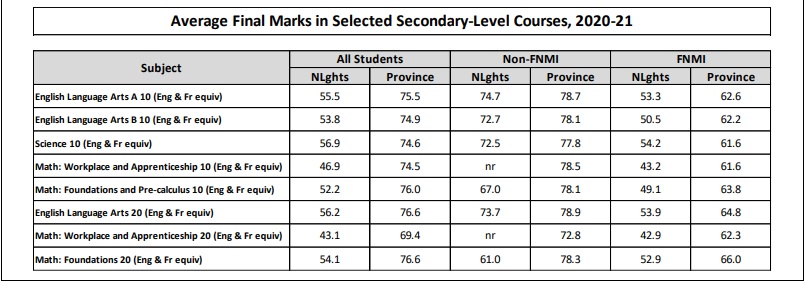
Credit attainment and overall Grade 10 marks in select classes are also low. Math in particular is concerning as average final marks for Math 10 is 47 per cent and Math 20 is 43 per cent. The provincial averages in math are 74 per cent and 69 per cent respectively.

Average final mark data for 2020-2021. (Submitted image/Northern Lights School Division)

“I’m not surprised by our results, but obviously we want to see graduation rates much higher than what they are now,” Young said. “In terms of students we are enrolling in high school, we want to encourage them to be taking more than a couple of courses. They can take four to five classes in each semester. If they take a full course load, then they are on track to complete their high school experience in three years.”

A positive aspect of the annual report shows the percentage of Grade 3 students reading at or above grade level continues to move upward. Grade 3 reading levels are considered a leading indicator of future student performance.

In 2016, only 28 per cent of Grade 3 students were at or above their reading level. That jumped to 51 per cent in 2019.

“That is very promising. It’s great to see our literacy data is trending upward,” Young said.

The NLSD consists of 22 schools located in 17 communities and it roughly covers the top half of Saskatchewan. In 2021, the division employed the full-time equivalent of 681 employees, including 292 classroom teachers, 267 other educational staff that support programming and 68 workers in operations and maintenance.

Read more data in the NLSD annual report online here.

derek.cornet@pattisonmedia.com

Twitter: @saskjourno

View Comments