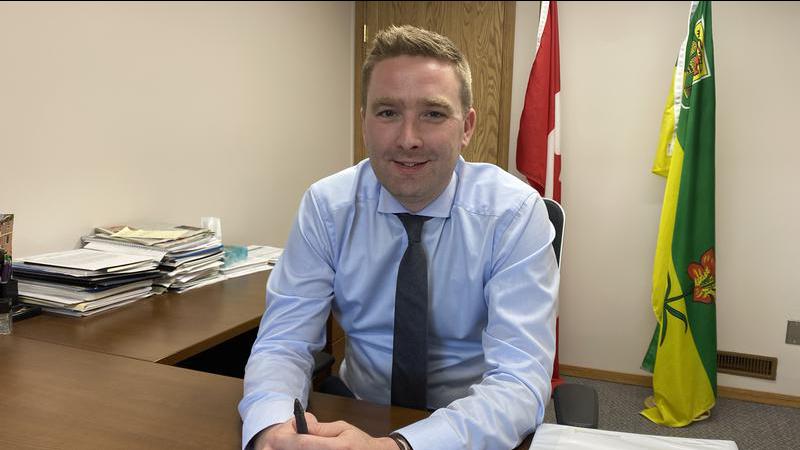
Jeremy Cockrill (File photo/battlefordsNOW Staff)
Catching Up with Cockrill

Cockrill highlights major health initiatives, recruitment efforts, and community support in the Battlefords

Jul 29, 2025 | 5:30 PM

Saskatchewan Health Minister and Battlefords MLA Jeremy Cockrill caught up with battlefordsNOW earlier this week, highlighting a series of new initiatives aimed at improving healthcare access, boosting recruitment, and supporting vulnerable residents in the Battlefords and across rural Saskatchewan.

Last week, the Saskatchewan Health Authority announced 77 new full-time healthcare positions across 30 rural and remote communities, including four in the Battlefords. These positions are either brand new or converted from part-time and casual roles to permanent full-time to help address staffing shortages and frequent service disruptions.

“We took a look at all the communities that we’ve had service disruptions because we haven’t been able to fill spots,” said Cockrill. “What we see is a challenge around temporary or part-time positions not getting filled. Especially in smaller communities, if you’re going to attract someone from Saskatoon, Regina or Prince Albert, you need a full-time position.”

In the Battlefords, three of the new positions are nursing roles at Battlefords Union Hospital, now eligible for a $50,000 Rural and Remote Recruitment Incentive over three years.

“That incentive is now available to new grads or nurses relocating from other provinces. Maybe it’s not the only reason someone moves, but $50,000 over three years certainly helps,” said Cockrill.

Since 2022, Saskatchewan has added 315 new or enhanced healthcare positions through its Health Human Resources Action Plan, part of the government’s broader strategy to stabilize rural healthcare.

Cockrill also addressed staffing challenges in diagnostic imaging at the local hospital. “I’m well aware of the challenges that present for running our emergency department and people being able to get timely care,” he said, noting that increased healthcare training opportunities are expected to ease some of the pressure in the coming years.

Expanding Access Through Nurse Practitioners

The province is also moving forward with a new funding model for nurse practitioners (NPs), aimed at allowing them to operate more independently and provide publicly funded primary care services.

“Something that we’ve been certainly hearing from communities all over the province, including in ours, is really the desire to see more nurse practitioners,” said Cockrill. “For many people in the province, they may not have a family physician, but they go see a nurse practitioner for their primary care needs, and we actually have that in Battlefords, with nurse practitioners currently practicing at our primary care center.”

Under the plan, NPs can sign contracts directly with the Ministry of Health, similar to physicians, and operate their own clinics. The government received over 70 expressions of interest, and as of last week, 13 formal applications were underway. The province expects to have the first independent NP contracts signed later this year.

“This will really help in terms of providing better primary care access to people,” Cockrill said.

Drug Treatment Court Launches

In a major step toward addressing addiction-related crime and recovery, the province recently launched a Drug Treatment Court in North Battleford, a program designed to support individuals struggling with addiction who are caught in the criminal justice system.

“There’s no penalty too harsh for those trafficking drugs into our communities,” said Cockrill. “But for those who’ve fallen into a life of addiction, we need to do everything we can to provide them an opportunity to choose recovery.”

Cockrill went on to say that the court is already showing promise, with stories of participants regaining employment, reconnecting with family, and reintegrating into society.

“I think over time we’re going to see some really positive results. I think having the drug treatment court available in our community recognizes it takes multiple efforts sometimes for people, and that support is available for people who want to take another swing at recovery,” he said.

Managing Measles and Vaccine Awareness

Cockrill also addressed the recent rise in measles cases in Saskatchewan, with 64 reported between March and late July.

“Thankfully, we haven’t seen the same growth other provinces have,” he said. “But so much of controlling infectious diseases is having good awareness. If they are infectious, staying home and isolating, and we’ve talked about how important vaccination is for measles. People that have had the vaccination can really help prevent some of the worst outcomes.”

As part of its response, the province recently lowered the eligible age for measles vaccination to six months in communities with active transmission, earlier than the standard 12 months.

“That subtle change has helped put parents’ minds at ease,” Cockrill noted.

“Saskatchewan Is Calling”

The province’s recent physician recruitment campaign, “Saskatchewan is Calling,” continues to generate interest from across Canada and abroad. The initiative promotes Saskatchewan as a desirable place to work and live for physicians and healthcare workers.

“We’ve been communicating via e-mail and telephone with a few potential candidates,” said Cockrill. “There’s a process because we have to make sure we have concerns around licensing process at ease. Typically, people also want to come and visit the facility they’d be working and visit the community and that’s really what the campaign was intended to do, to get more people into that process. And we are seeing increased numbers in terms of interest being shown.”

Austin.mattes@pattisonmedia.com

On X: @AustinMattes

View Comments