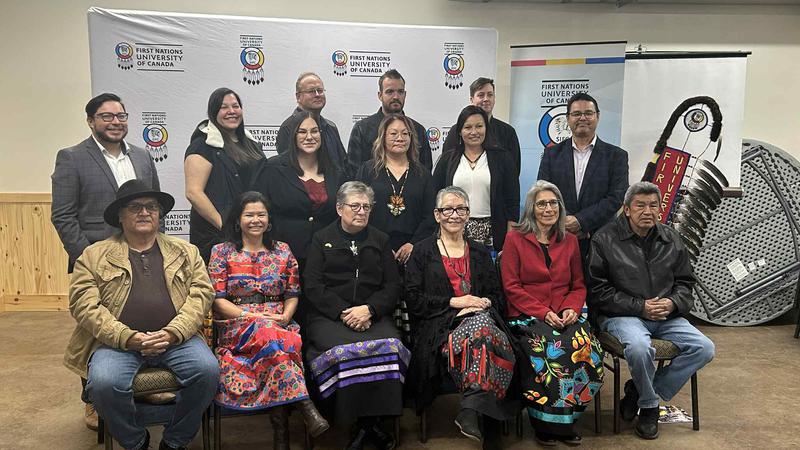
Members of the First Nations University of Canada celebrated infrastructure upgrades to it's fourth campus - a land-based learning centre located near St. Louis, Sask. (Nick Nieslen/paNOW)
nēwoskan

FNUniv celebrates upgrades to traditional campus near St. Louis

Oct 22, 2025 | 3:07 PM

To the general public, it’s just 22 acres of land that runs along the South Saskatchewan River across from St. Louis. To students from the First Nations University of Canada (FNUniv), the land is their teacher.

“This location is very important for the university, and, of course, it has to do with the spiritual connection,” said FNUniv president Jacqueline Ottmann.

The nēwoskan Traditional Campus is located about 30 kilometres south of Prince Albert and serves as a permanent land-based learning environment where students, Elders, and Knowledge Keepers gather for Indigenous social work, education, language culture camps, ceremonies and traditional teachings.

It has been used since 2021, but on Wednesday the university celebrated the renewal of the location it refers to as its fourth campus. Projects included upgrades to the mess hall with a kitchen, water and wastewater infrastructure, showers for students, air conditioning units and an enclosed sweat lodge. The upgrades totalled $3.4 million; FNUC contributed $1 million while the federal and provincial governments invested $2.4 million, in part through the Canada Infrastructure Program.

“This land provides students opportunities to learn from the environment, to disconnect from the cities, to engage in meaningful ways with each other, to listen to the coyotes at night, to see the brilliance of the stars, and to be open to healing in various ways,” Ottmann said. “And that’s what we’ve heard also is the nurturing of identity…First Nations, Indigenous ways of knowing, being, and doing. And, also through that nurturing, comes layers of healing.”

While the educational experience is rooted in Indigenous traditions and cultures, students also learn about environmental stewardship and sustainability. Ottman said the campus being in the midst of nature allows students to disconnect from various distractions that could act as barriers to deeper forms of learning.

“First Nations University represents a decolonized approach to teaching and learning and research and its not only decolonized, its Indigenous. So here we have the freedom to exercise traditions whether it’s lifting pipe as we did today – so it is a significant step towards healing from those experiences that were imposed upon Indigenous peoples.

Like Murray Sinclair said, ‘education got us into this mess, and it should get us out’ and that’s our role here.”

panews@pattisonmedia.com

View Comments