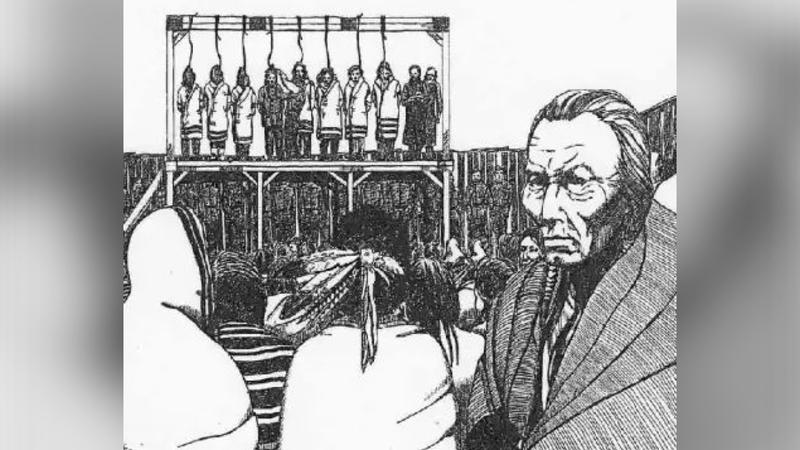
Illustration of the eight warriors who were hanged in 1885. (Canadian History Ehx/Facebook)
feast

Annual feast honors eight Indigenous warriors hanged in 1885

Nov 27, 2025 | 6:14 PM

“They wanted to fight for our people,” said Shona Poitras after the annual feast to honor the indigenous warriors who were hanged in 1885.

On November 27, 1885, 140 years ago, eight Indigenous men lost their lives in Battleford during Canada’s largest mass hanging. The men were found guilty of murder in the Frog Lake Massacre and the looting of Battleford during the North-West Rebellion. However, historical perspectives argue they were not given fair trials, and their actions were driven by desperation, starvation, and self-defense.

On Thursday, Kanaweyimik Child and Family Services hosted a feast at Fort Battleford. A large group of people gathered to remember the eight significant names: Wandering Spirit, Round The Sky, Bad Arrow, Miserable Man, Iron Body, Little Bear, Crooked Leg and Man Without Blood.

Shona Poitras was one of the people who participated in the feast; she said the feast is a spiritual ceremony.

“You get to have a meal with the loved ones that passed on. It’s always a good thing to be able to feed the spirits because it keeps them peaceful in heaven.”

The event included a pipe ceremony where local First Nations Elders blessed all the food. Helpers brought Items into the ceremony one by one to be smudged then served Elders, then the rest of the group in an orderly fashion.

Christine Swifwolf was another participant in the feast; she said it is important to smudge the food used in the ceremony.

“When we smudge our food, it purifies and it becomes an opening for the spirits to come when the food is smudged,” said Swiftwolf.

Once guests involved in the feast received their food, everyone put aside a small portion to be returned to the spirits. The food offerings were then placed in a bowl at the warrior’s gravesite located East of Fort Battleford.

Swiftwolf said remembering the 1885 mass hanging is important for everyone, not only indigenous people.

“It impacts everyone historically. It becomes generational when somebody is harmed in our First Nations, it affects everybody.”

alyssa.rudolph@pattisonmedia.com

View Comments