Erin Brown captured footage of the tornado south of Oxbow on Tuesday, June 9, 2026. (Image Credit: Erin Brown/Facebook)
Destructive Storm

Tornado that destroyed Alameda farm was strongest in Sask. since 2010

Jun 12, 2026 | 9:17 AM

The tornado that flattened an Alameda farmyard on Tuesday was the strongest Saskatchewan has seen in more than a decade.

The Northern Tornadoes Project, a research group based at Western University, assigned the tornado a preliminary rating of EF3 on the Enhanced Fujita scale, which can have wind speeds from 225-265 kilometres per hour.

The last tornado in the province to receive a similar rating destroyed homes on Kawacatoose First Nation on July 2, 2010.

Dylan Painchaud-Niemi, a research meteorologist with the Northern Tornadoes Project, was out surveying the wreckage left at the farm south of Alameda. He said ratings that high are fairly uncommon in Saskatchewan.

“It’s fairly rare for it to hit a property, and especially at this magnitude,” he said.

Painchaud-Niemi said the research group was still figuring out the path of the tornado that tore through the farmyard.

Danny Brock said he and three of his kids hid in the basement bathroom after he saw the tornado coming up his drive on Tuesday evening.

He said he heard the growl of the wind as his home was shredded apart above his head.

“You know what goes through your head when something like this is happening? Hope to God that you’re going to make it alive,” Brock said.

Nobody in the family was hurt, but the family’s dog died during the storm.

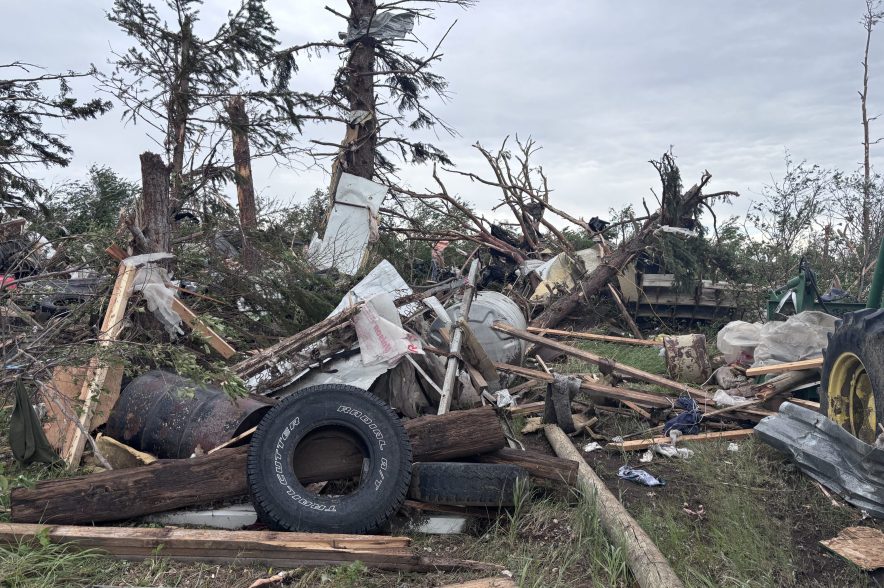
A tornado swept through the Brock family’s farmyard on Tuesday, toppling trees and destroying much of their home.
A tornado swept through the Brock family’s farmyard on Tuesday, toppling trees and destroying much of their home. (Image Credit: Gillian Massie/CJME)

Painchaud-Niemi said the family was very lucky to escape without injury.

“It’s a miracle. I’m really happy that no one was hurt at all,” Painchaud-Niemi said.

“Just unfortunately, you have to deal with the massive cleanup and rebuilding.

An online fundraising page has been set up to help the Brock family with expenses after the destructive storm.

Environment Canada’s early data clocked the tornado’s wind speeds at 245 kilometres per hour.

Meteorologist Terri Lang said tornadoes that strong can form when warm, humid air triggers the surface of a thunderstorm in motion.

“The other important piece is the way the winds occur in the upper atmosphere,” she said.

“We need them to kind of turn as they go up through the atmosphere and strengthen, and that allows the storm to kind of grow on its own, and also allows it to spin.”

Lang said Environment Canada meteorologists are still determining the path of the twister and looking through radar scans for more information.

View Comments