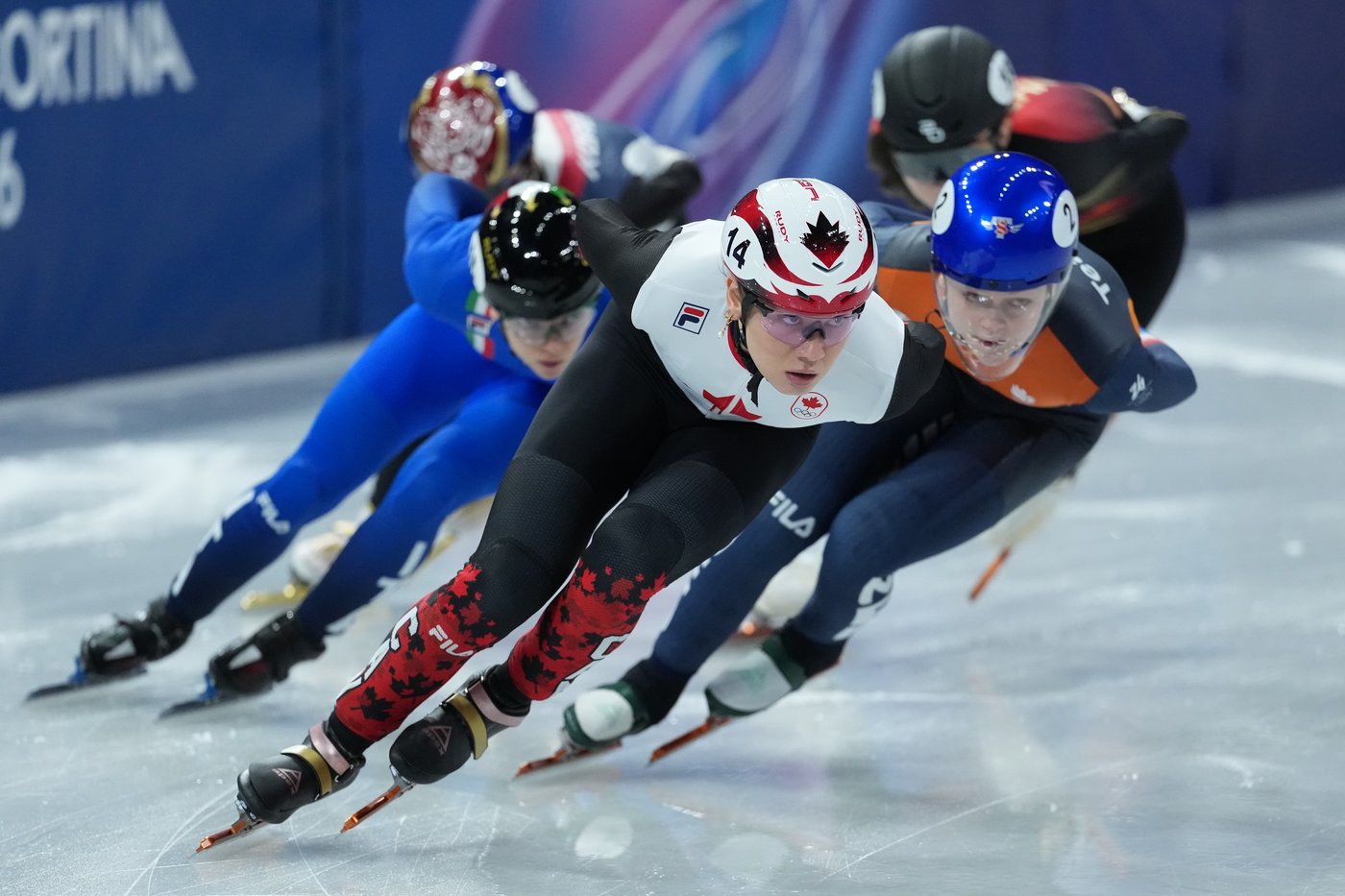
Canada's Courtney Sarault, centre, competes in the women's 1,000 metre short-track speedskating finals at the 2026 Winter Olympics, in Milan, on Monday, February 16, 2026. THE CANADIAN PRESS/Darryl Dyck

Canadian short-track speedskaters aim to balance life on and off the ice

Oct 21, 2026 | 7:56 PM

VANCOUVER — Courtney Sarault is coming off of a crazy year.

The Canadian short-track speedskater knew that pursuing her dream of winning Olympic medals would be all encompassing.

“There wasn’t really much life outside of speedskating, which was fine because it’s my passion and it’s something that I love and it’s a goal of mine to be really good in the Olympic year,” she said.

The dedication paid off with Sarault winning four medals — two silver and two bronze — at the Milan Cortina Olympics in February. She also captured a Crystal Globe on the World Cup circuit as the best overall female speedskater of the season.

Now Sarault and her Canadian teammates are resetting as a new four-year Olympic cycle begins with the ISU Short Track World Tour.

The seven-city competition begins in Vancouver, with more than 215 athletes from 29 countries racing around the frozen track Friday through Sunday. The Montreal portion takes place Oct. 30 through Nov. 1.

The Vancouver stop marks the first time Pacific Coliseum has hosted short-track speedskating since the 2010 Olympics.

Those Games were “iconic,” Sarault said.

“Those Olympics were the ones that opened my eyes a lot as a young athlete in short-track speedskating,” she said. “So being able to come back, maybe all it takes is one competition or one little thing to kind of spark someone’s interest in the sport.”

The 26-year-old from Moncton, N.B., is one of 12 Canadians competing in Vancouver this weekend, and she said her benchmarks for success are different heading into the first year of a new Olympic cycle.

“I don’t expect to be winning races right now,” Sarault said. “I want to be in the race, I want to be challenging, and I want to just try my best. And my goal is to be more in my final form and my better shape towards the end of the year at the world championships. Because I have yet to be a world champion in individual distance.”

This year is about resetting and enjoying life a little bit, she added, and that means exploring new opportunities while continuing to compete.

In recent months, Sarault has given motivational talks at schools, rode a horse in the Calgary Stampede and been introduced on the ice at a Montreal Canadiens game.

It’s been a refreshing change from her in-season routines, she said.

“I think it’s easy to fall into your own little world in speedskating,” Sarault said. “We go to the same rink, we do the same thing every single day. We skate in the same direction in a circle every single day, see the same people.

“It opened the social side that I enjoy, and I got to kind of do that more and be more that version of myself versus that just really locked-in mode. I think it helped a lot just to kind of recharge my batteries and hear other things and see other things and see that there is life outside of my little cave that I skate in all the time.”

For her teammate Steven Dubois, finding balance has looked a little different.

The 29-year-old from Lachenaie, Que., won Olympic gold in the men’s 500 metres and silver in the mixed team relay in Italy, but said the Canadians weren’t entirely happy with their results.

“We had a little bit of trouble last year at the Games with, I guess, a different type of ice that we didn’t really skate before,” he said. “So it’s something that we want to work on, and it kind of works well that we get to try different types of ice even more this year because there’s more competition and new cities. So I think it works well into our plan for the next four years.”

In between stops on the tour, Dubois is hitting both the books and the ice as he juggles training with biology courses at the University of Montreal.

The five-time Olympic medallist plans to become an optometrist when he eventually hangs up his skates and isn’t sure yet whether he wants to chase a third Winter Games.

For now, he’s both skating and studying.

“It’s hard because I think, especially for us (professional athletes), we’re kind of used to doing everything 100 per cent and it’s hard to do both at 100 per cent, especially when you’re missing classes and training,” Dubois said.

“But I’m trying to do the best I can in both. It kind of feels sometimes I’m not doing enough. But I get good grades and I get good results. So I don’t know what to expect more.”

Leaving elite speedskating isn’t easy, said Maxime Laoun.

The 30-year-old from Montreal contemplated retiring after breaking his leg in October, just months before the Olympics. It was the second time he’d broken a leg speedskating. The first injury — a triple fracture in 2019 — saw him sidelined for over a year.

But Laoun keeps coming back.

“There’s something about it,” he said. “Because last year was like, ‘Oh, maybe it will be the end of my career.’ And then I took off on vacation and I was like, ‘I miss it. I miss the feeling of going fast. I miss everything about it.’ So there’s something addictive about the sport, and that’s why I’m still here.”

Laoun narrowly missed the podium in Italy, finishing fourth in the men’s 5K relay, the event where he won gold at the Beijing Olympics.

Whether he’ll chase another Olympic medal remains to be seen.

“I’m just taking one step at a time and really enjoying it,” he said. “I think … if you do the full quad, it’s a really long one. And just to be able to enjoy your sport and figure out what’s important and how to improve, that’s the most important.”

This report by The Canadian Press was first published Oct. 21, 2026.

Gemma Karstens-Smith, The Canadian Press