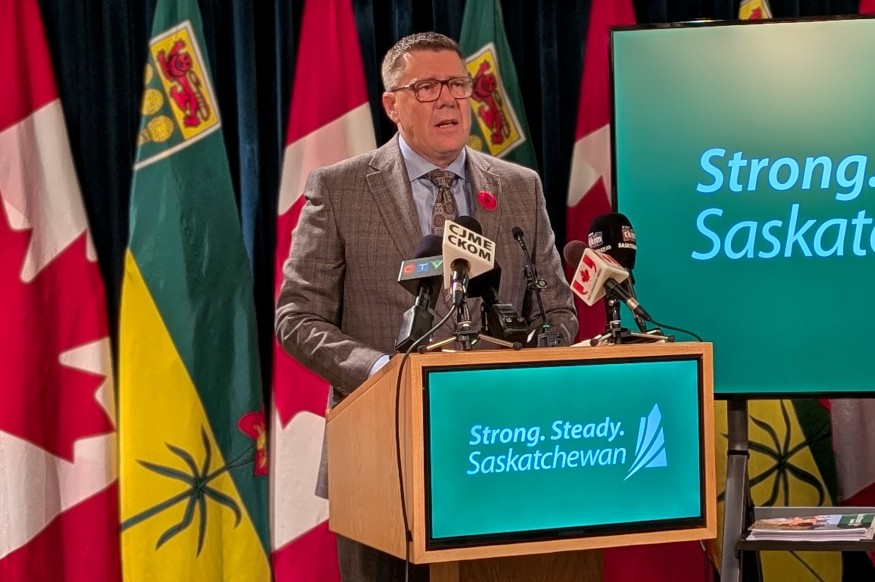
In the throne speech on Tuesday, Oct. 27, Premier Scott Moe’s Saskatchewan Party government promised income tax reductions, greater oversight in care homes, new addictions treatment spaces and legislation imposing limits on medical euthanasia. (Image Credit: Lisa Schick/980 CJME)
Provincial politics

Senior care, MAID and AI: Key takeaways from Saskatchewan’s Throne Speech

Oct 27, 2026 | 2:26 PM

The fall session of the Saskatchewan Legislative Assembly kicked off Tuesday, with Premier Scott Moe’s government outlining its priorities and promising several new laws in the throne speech.

It includes legislation to provide greater oversight and accountability in personal care homes, restrictions on assisted dying, stronger administrative penalties for impaired drivers, and a law aimed at preventing the misuse of artificial intelligence.

“This is a very turbulent time in the world. Trade wars and actual wars are disrupting economies and businesses and jobs and families,” Moe told reporters at the legislature.

“But in the midst of all of that, there is a place whose economy stands rock solid. That place is our place, strong, steady Saskatchewan. And today’s speech from the throne is about ensuring that all of that continues, no matter what is happening beyond our borders.”

Here’s what you need to know about the provincial government’s priorities for the year ahead:

Seniors First

The government will introduce The Safer Homes for Seniors Act, a measure designed to improve oversight, transparency, and accountability in personal care homes.

There are few details about what that means, but Premier Scott Moe maintained it is about setting expectations.

“We want to revise the regulations to some degree on what the expectations are, what’s required in making a seniors’ home safe, but also I would say a revision of the penalties if that is not the case. We want to ensure that our loved ones, our parents and grandparents, have a safe place to stay, and we can be assured from the government regulatory perspective that it is a safe place,” Moe said.

The Government of Saskatchewan says it will unveil the next steps in its health-care plan during the fall session. (Lara Fominoff/650 CKOM)

Patient Plan

This fall, the government will announce the next steps in its health-care plan during the fall session, aiming to improve access to diagnostics, surgery and primary care.

But Moe did not expand on the details of those next steps.

“I would say that you’re seeing steps occur every day in the investment in patients’ first healthcare plan, which is very focused on improving access to healthcare generally, but to primary healthcare professionals, and improving the timely access that we have to surgery,” Moe insisted.

Legislation will also be introduced to expand the scope of practice to several more health-care professionals.

The provincial government plans to bolster administrative penalties for impaired driving during the fall legislative session. (Saskatchewan RCMP/YouTube)

Tackling Impaired Driving

Addressing a series of fatalities on Saskatchewan highways this summer, the government is taking measures to help reduce rates of impaired driving.

It is proposing changes to The Traffic Safety Act to enhance the admistrative penalties impaired drivers face in the province, while giving the province the ability to cancel, suspend or refuse to issue a driver’s licence to individuals convicted “of certain drug-related offences.”

MAID in Sask.

The government has heard from residents who believe there needs to be more safeguards around medical euthanasia, which is commonly referred to in Canada by the acronym “MAID” (Medical Assistance in Dying).

It is being done by the federal government, but Moe wants a Saskatchewan approach as well.

“I think the provincial piece of legislation is very much going to be in line with the federal piece of legislation, just creating some safeguards with respect to access to MAID. We have heard from Saskatchewan individuals and families that are supportive of having access to MAID in certain instances. And so what we are doing is, through those conversations with people, with healthcare providers, providing those safeguards to ensure that, yes, it is available, but here are the scenarios on where that may be limited,” Moe explained.

Artificial Intelligence

The use of AI is growing, and while the government said many of the uses of the new technology are positive and helpful, and includes one of the biggest AI data centres in Regina, some bad actors are using it for deceit and fraud.

That’s why the province promised to introduce a new act prohibiting “the misuse of AI-generated voices and images involving elections, consumer transactions and the protection of privacy.”

“This is the second part of the conversation around AI. One is the location of where you’re storing it, under what law it is being governed, and then two is what guidelines we can actually put on how AI is being used. Is it being used for nefarious purposes, for criminal purposes? So this is part of putting together some of the guidelines around AI. I think as we move through the next months and years, you’re going to see these types of initiatives and consultation at the federal level as well,” Moe explained.

Other new laws

Another step is being taken to tackle illegal drugs on Saskatchewan streets. The Opioid Damages Act will be used to recover health-care costs from those who make and are involved in opioid wrongdoing.

The province also plans to introduce The Mandatory Testing and Disclosure Act during this session, a measure designed to protect any victim of crime or first responder who “reasonably believes they have come into contact with an individual and are at risk of exposure from Hepatitis B or C, or HIV.”

If that occurs, the government said the individual will be able to apply to the courts to have “the source individual” tested for those diseases.

Another new law coming this session will require workers in the hospitality and ridesharing industries to inform police “when there is a reasonable suspicion to believe that another person is subject to human trafficking.”

The government plans to restrict protests that disrupt critical ‘infrastructure and transport routes’ with The Protection of Economic Infrastructure Act.

Moe maintained that protests do not include labour action.

“I think just over a decade ago we saw a northern road that was blocked. Not too long ago, we saw a rail line that was attempted to be blocked in the City of Regina, and we know across Canada we’ve seen that as well. And so what we’re doing is enhancing the current legislation that we have to be responsive and part of our broader effort and initiative to keep our communities safe and to keep our economy moving.”

View Comments