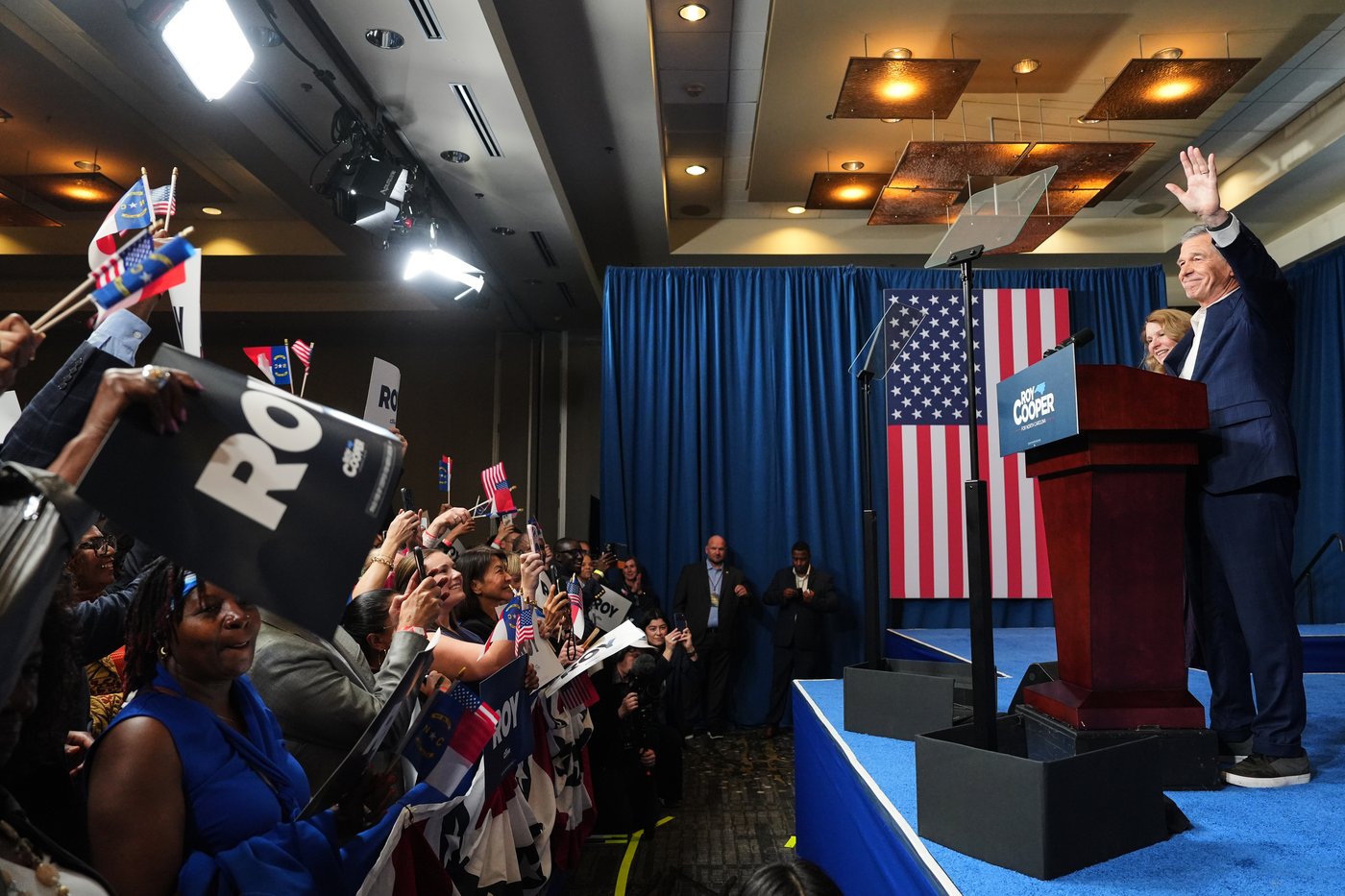
North Carolina Democratic Senate candidate Roy Cooper speaks at an election night event Tuesday, Nov. 3, 2026, in Raleigh, N.C. (AP Photo/Matt Ramey)

Democrat Roy Cooper wins North Carolina Senate seat, flipping a key GOP-held seat

Nov 3, 2026 | 7:39 PM

RALEIGH (AP) — Democrats in Washington believed early in the midterm campaign cycle that former North Carolina Gov. Roy Cooper would be their biggest recruiting win as they tried to forge a once-unthinkable path to a Senate majority.

His state’s voters ratified their confidence Tuesday, delivering Cooper his seventh statewide electoral victory, this time over President Donald Trump’s handpicked Republican candidate Michael Whatley, to flip a key seat in the national battle for Senate control.

The result affirms Cooper’s appeal across a North Carolina electorate that backed Trump in the last three presidential elections. But the president’s standing has fallen and Whatley, the former chairman of the state and national party, was never able to find his footing on the campaign trail.

“Tonight, we showed the country that when everyday people come together, we can make change,” Cooper told a crowd of energetic supporters in Raleigh, pledging to get straight to work in Washington on affordability, which he centered in his campaign.


Cooper said he would push to bring down the cost of gas and groceries, end the war in Iran, and take on corruption and special interests, promising to be an independent voice for North Carolina in a speech that also drew from the Bible and touched on the state’s history.

“I’m not going to Washington to be something; I’m going to Washington to do something,” Cooper, 69, said to rousing cheers from the crowd.

Cooper will succeed Republican Sen. Thom Tillis, who opted not to seek a third term after clashing with Trump over his signature “big beautiful bill” last year. The feud helped cost Republicans an incumbent who may have been tougher for Democrats to dislodge, and Tillis has emerged as an increasingly outspoken critic of the president.

Cooper is 1st Democratic senator-elect since 2008

Although the state routinely elects Democrats as governor, it usually sends Republicans to the Senate. Cooper is North Carolina’s first Democratic senator-elect since 2008 and just the fourth in the last 50 years.

Whatley, throughout the race, latched himself to Trump’s side.

“I am honored that we are going to have the greatest president of our lifetime, Donald J. Trump, here,” Whatley said ahead of a metro Charlotte rally with Trump days after mail ballots were distributed.

Cooper, while broadly critical of Trump’s policies, typically avoided personal broadsides against the president.

Cooper’s approach was a notable contrast to some other Democratic Senate candidates in battleground states, including his neighboring Southerner, Georgia Sen. Jon Ossoff, who routinely hammered the president as inept and corrupt. But Cooper’s tack fit his long-established reputation in North Carolina, and it tracked how he was elected governor in 2016 and 2020 in the same elections that Trump carried the state.

As he did in those elections, Cooper corralled Democrats’ base of Black voters with younger voters and more liberal white voters, while adding enough support from independents and a larger share of conservative rural and small-town voters than Democrats typically muster.

Registered Democrats and Republicans in North Carolina are split about evenly, while independent voters outnumber both. Strategists in both parties said ahead of the campaign that the independent cohort of more than 3.5 million voters was more concerned about the economy, an issue where Trump is weaker than he was in 2024, than with crime or immigration, issues where North Carolina Republicans might still have an advantage over Democrats.

The landscape was difficult enough for Republicans that they also were worried about a handful of North Carolina congressional districts that had once been presumed safe for the party in a midterm election.

Early in the night, Democrat Jamie Ager, a farmer, flipped a western North Carolina congressional seat, despite a strong Republican voting history in the district. Ager defeated Republican Jennifer Balkcom.

Trump elevated Whatley, backed him

For Trump, Whatley’s defeat is as crushing a blow as any in this midterm cycle. He elevated Whatley from his state party chairmanship to the Republican National Committee chairmanship during the 2024 presidential campaign, flexing his control over the party as he sought a return to the White House. When he first endorsed him for Senate, Trump hailed him as “one of the most capable executives in our country.”

The campaign played out as an example of how Republicans struggled nationally to capitalize on their sweeping 2025 tax and domestic policy law as they’d planned. Whatley embraced the so-called “big beautiful bill” for its tax breaks on overtime pay, tip income and Social Security benefits.

But according to the AP Voter Poll, most voters in North Carolina thought Whatley was “too supportive” of Trump.

Cooper, meanwhile, was largely perceived positively by voters. More than half of North Carolina Senate voters did not think his views were “too extreme.” Most voters also “somewhat” or “strongly” approved of Cooper’s performance as governor.

Voters were less likely to say they were contacted by Whatley’s campaign than Cooper’s. About 4 in 10 North Carolina Senate voters said they were contacted by the Cooper campaign, while only about one-quarter said they were contacted by the Whatley campaign.

Cooper highlighted the realities consumers faced at the gas pumps, at the grocery store and when trying to access healthcare and affordable housing.

The former governor pitched North Carolina’s Medicaid expansion achieved while he was governor as a demonstration of his priorities. But Cooper also avoided making a litany of specific policy proposals and promises — another longstanding strategy that allows him the flexibility to maintain his more moderate identity.

Cooper, who has not lost an election in a long political career that began in the state House in the 1980s, is “woven into the fabric of North Carolina,” Anderson Clayton, who leads North Carolina’s Democratic Party, said in an interview at Cooper’s watch party.

Cooper faced attacks on crime, hurricane response

Cooper withstood withering Republican attacks that he was weak on crime as governor and, before that, as a four-term state attorney general. Trump, in social media posts and multiple trips to campaign on Whatley’s behalf, escalated those attacks, describing North Carolina’s cities as “blood-soaked killing fields.” North Carolina’s violent crime rate ranks in the middle third of states, according to FBI statistics.

The president also drew fault lines over the response to Hurricane Helene. The 2024 storm battered western North Carolina in the final months of Cooper’s second term as governor and as Trump was campaigning to return to the White House. Trump said Cooper “did nothing” to help storm victims. Cooper has long rejected that accusation, pointing to the work state and local governments did with the Federal Emergency Management Agency, which Trump has since attempted to gut.

Bill Barrow And Sarah Rankin, The Associated Press