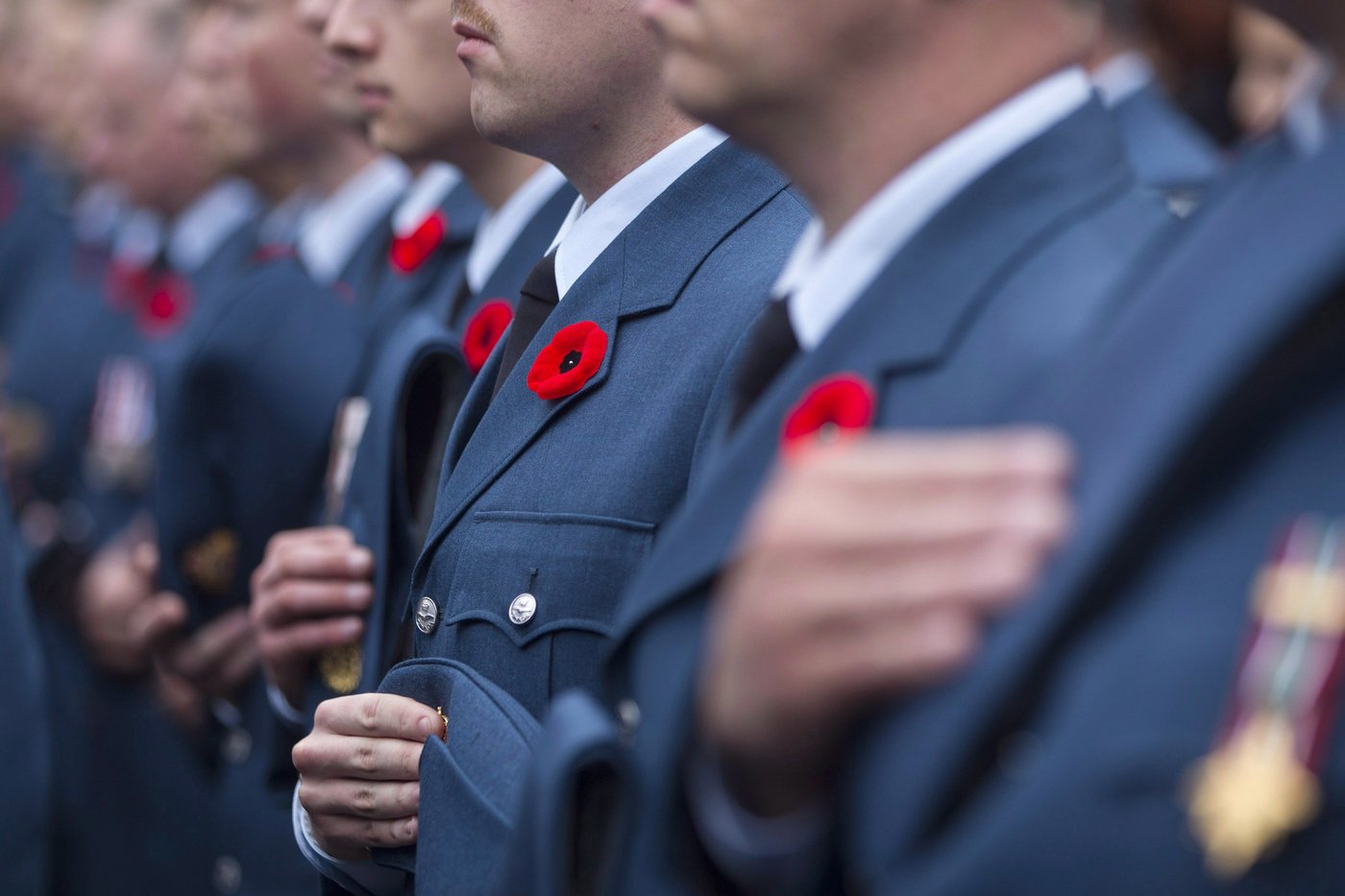
Members of the Royal Canadian Air Force remove their hats as a prayer is read during a Remembrance Day service at Toronto's Mount Pleasant Cemetery, on Wednesday, Nov. 11, 2015. THE CANADIAN PRESS/Chris Young

Fact File: Military chaplains can’t lead prayers on Remembrance Day; no blanket ban

Nov 10, 2026 | 2:31 PM

Recent social media posts claim Canadian Armed Forces chaplains have been banned from saying prayers on Remembrance Day, or that prayers and references to God are banned among members. A policy directive issued by the military in July does instruct military chaplains not to say prayers during official ceremonies or events, including Remembrance Day. Instead they are told to offer “spiritual reflections” that use neutral language and do not refer to God. Chaplains may still pray and refer to God at funerals or faith-specific events, and the directive does not limit members’ personal religious beliefs.

THE CLAIM

Recently, multiple social media posts claimed Canada’s military chaplains are banned from prayer during Remembrance Day ceremonies on Nov. 11.

“All Canadian military chaplains speaking at Remembrance Day ceremonies across Canada will not be permitted to pray or use the words Jesus or God,” reads a Nov. 3 Facebook post.

Other posts related to the ban claimed Canada does not let its military mention God.

THE FACTS


Though the military traditionally had only two chaplain branches — Roman Catholic and Protestant — it has since expanded to include Jewish, Muslim, Buddhist, Indigenous and other spiritualities.

In 2023, a policy directive signed by the military’s chaplain general, J.L.G. Belisle, encouraged chaplains to use inclusive language when addressing Canadian Armed Forces members in public. While the policy urged religious neutrality, it did not tell chaplains to refrain from referring to God or using other religious language.

In July 2026 a new directive replaced the 2023 policy and set out the expectations for members if called to speak at a public ceremony.

Under the new rules, those who are speaking in public in their capacity as Canadian Forces members must adhere to “state religious and spiritual neutrality.” That means chaplains cannot use words, actions or symbols that are associated with a specific religion or spiritual belief.

For any events “connected to official government business,” including military ceremonies and Remembrance Day commemorations, chaplains are told to replace prayers with spiritual reflections. “Spiritual reflections do not use religious specific language, including references to God, etc.,” the policy states,

The military defines a spiritual reflection as a public speech that encourages “meaning, purpose and spiritual well-being.”

The Department of National Defence said in an emailed statement Tuesday that chaplains remain an important part of Remembrance Day ceremonies.

“Commemorative elements, including acts of remembrance, moments of silence, wreath-laying, historical tradition, and recognition of veterans and the fallen, remain unchanged,” the department said, adding that many faith communities may choose to organize voluntary prayers or religious services at their own Remembrance Day events.

The new policy does not ban military members from invoking God or from praying in private or at religious ceremonies such as mass. Upon request, chaplains can use prayers, including references to God, at military and state funerals.

They may also continue to lead prayers in private conversations or at faith-specific gatherings and worship events.

The directive notes that Canadian Forces members have freedom of religion, including the freedom to have no religious beliefs. “The (Canadian Armed Forces) must uphold and respect the Charter rights of our members and members of the public by maintaining religious and spiritual neutrality in the exercise of our public duties,” the policy says.

For cultural and educational purposes, the policy makes room within military ceremonies for Indigenous practices, which can have spiritual elements. “Their inclusion supports reconciliation objectives and efforts to strengthen relationships between (Canadian Armed Forces) members and Indigenous peoples,” it says. It adds that the inclusion of Indigenous practices “must remain consistent with the duty to maintain religious neutrality.”

This report by The Canadian Press was first published Nov. 10, 2026.

Marissa Birnie, The Canadian Press