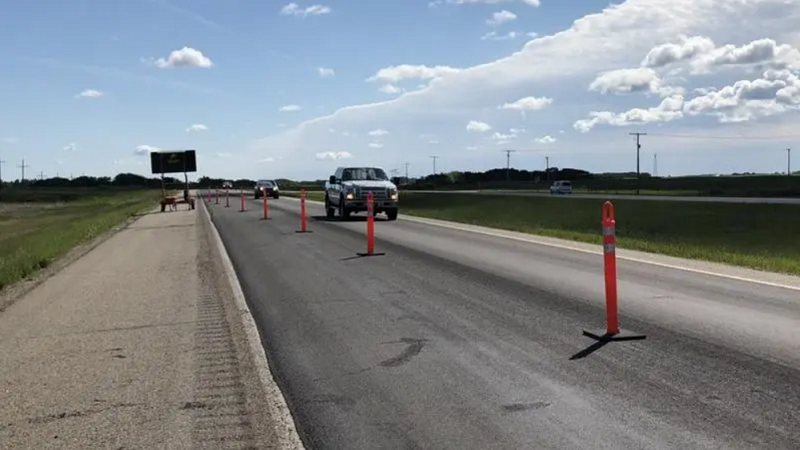
(Andrew Shepherd/980 CJME).
Saskatchewan Fatal Crash Prevention

‘One too many for us’: province and trucking association respond to semi truck, construction zone related fatalities

Sep 4, 2020 | 6:17 PM

Two fatalities over the summer involving the commercial trucking industry, construction zones, and highways in Saskatchewan have sent shockwaves to numerous parties.

In July, a semi truck driver from Shellbrook faces charges in connection to a crash on a Manitoba highway that claimed two lives and injured 15 others. While one month later, a semi driver received charges after a crash on Highway 41 in Wakaw claimed the life of one man.

The Saskatchewan Trucking Association (STA) and Ministries within the Government of Saskatchewan expressed condolences for the victims in the incidents and provided input on how highways can be safer for residents, semi drivers, and highway workers.

‘Adopt the federal hours of service’

Susan Ewart, executive director of the STA, said she isn’t aware of instances with workers associated with the STA claiming negligence from the employer. However, she mentioned truckers following the proper hours of service – an average day of 13 to 14 hours total – is key to managing their fatigue and safety on the road.

Even most commercial trucking is federally regulated, Ewart said there are two types of hours of service regulations: provincial and federal. She believes all provinces and companies adopting the federal hours of service regulations – which includes electronic logging devices beginning in June 2021 – will create an even playing field for truckers.

“It will allow a driver to more accurately record and keep track of their hours of service… they’ll do away from those paper log books,” Ewart said. “Logbooks can be hard to fill out. Typically, our members are making sure the logbooks are kept and reviewed, and their safety compliance people are checking them. We’d like to see [electronic logging devices] here in Saskatchewan as well for all carriers.”

101 fatal crashes involving semi trucks

According to statistics provided by Kwei Quaye, vice president of traffic safety services at SGI, there were 101 fatal crashes involving semi trucks in Saskatchewan from 2014 to 2019 in Saskatchewan. He added that approximately 42 per cent of the crashes involved semi truck drivers from out of province.

One of the 101 were in a construction zone, involving a driver from Manitoba in 2015.

Quaye called the occurrences of semi truck crashes in construction zones rare but said SGI’s intent is to see zero fatalities on Saskatchewan’s roadways.

“It’s not just a number for us, there are people behind it,” Quaye said. “The pain associated… it’s very difficult. Everyone is one too many for us.

“When there’s a crash involving a semi, just because of the physics, mass and speed of these vehicles, the outcomes are very unfortunate. When there’s an incident like this, we try to learn from it and see ways in which we can work with other agencies – including the Ministry of Highways – to prevent these types of crashes from happening on our highways.”

Quaye said the Government of Saskatchewan is also pushing for all provinces to adopt the federal hours of service regulations.

Public education the primary focus

The Ministry of Highways and Infrastructure in Saskatchewan said it does try to use deterrents for residents and semi truck drivers to obey the rules of the roadways, but the public education route appears to be its best method.

“As an agency, we will probably get more benefit from educating people,” Director of Communication David Horth said. “A lot of times you can’t enforce your way out of a problem. You want strong enforcement, so people recognize the consequences of their action. But there’s a great deal of benefit in getting people to do the right thing for the right reasons.”

Horth listed a provincial government advertisement encouraging drivers to slow down to 60km/h in construction zones – as fines triple for speeders – as public education, and Highway Patrol officers and photo radars at construction zones as deterrents.

According to Horth, all construction zones in Saskatchewan have safety accommodation plans that include multiple inspections every day. He said the Wakaw site was being inspected three times each day prior to August’s crash, and to the best of their knowledge, all the appropriate accommodations were in place.

Without giving specifics, Horth said the ministry intends to add more educational methods regarding construction zone, highway, and trucking safety precautions going forward. He encourages commercial and pedestrian drivers to be alert.

“It’s incumbent on every one of us to consider the safety of not just ourselves and the people travelling with us, but also the people we’re sharing the road with and the people who are repairing the road for us. We all deserve to get home to our families every night.”

aaron.schulze@jpbg.ca

On Twitter: @SchulzePANow

View Comments